Checkpoints as Nodes of Extraction
“Governance rarely vanishes; it reconfigures”
Derebe, 20251
Tracking unjust enrichment2 requires us to attend not only to its most spectacular moments, but also the quotidian instances and impacts experienced by Syrian civilians. Checkpoints are crucial in this process. Often situated along major roads, these manned posts act as arterial valves across a country, regulating the flow of goods, money and people.
In the following investigation spanning 2011-2024, we treat checkpoints as infrastructural nodes and position our analyses as speculative tools for spatialising, localising and making legible a range of practices, including extraction, extortion, political violence and population control. Practically, we sought to understand the relationship between the checkpoints’ materiality – in terms of both their architecture and geographic location – and their potential operations and functions. We propose the possibility that the material-spatial development and survival of checkpoints could serve as a useful proxy for tracking patterns of wealth extraction imposed by the regime onto civilians.
Our techniques and methodologies are critical, speculative and multi-faceted. Following a counter-forensic, poly-perspectival approach, our aim is to build tools that can be followed by new evidence. We used a variety of visual and spatial techniques including timelines of checkpoint evolution, maps of checkpoints as nodes along the axes linking the cities of Lebanon, Latakia and Homs, and satellite imagery and 3D models of specific checkpoints. For future counter-forensic analysis, we also developed a system of spatial typologies.
Amidst the uncertainty and flux caused by regime change, checkpoints can appear in an instant, can move, proliferate, dismantle and reconstruct. During the Syrian conflict3, checkpoint ownership was highly contested and variable as government forces and paramilitaries alike sought to control territory and the movement of people, whilst extracting wealth. Checkpoints can therefore become “an articulation and a microcosm of the different competing sovereignties“4. While they are concrete, blatant and violent to those who experience them, their broader functionality in the context of the Syrian conflict is more nuanced, unpredictable and obscure.
We created a collection of roughly 100 identified checkpoints from various sources such as ground reports5, witness testimony, open-source intelligence (OSINT), Syrian Observatory for Human Rights (SOHR) reports6, and press reports. Out of those we verified satellite imagery in dark grey, apart from about 20 in light grey, we then selected a representative set of checkpoints marked in red. While they are distributed across the Latakia-Homs-Damascus-Al Masnaa route, we focus on Homs. Some case studies illuminate the architectural and material elements of the checkpoints, while others demonstrate their operations, functions and activities.
All identified and selected checkpoints
Identified and selected checkpoints in Homs
We note throughout the many gaps and unanswered questions. For example, we were unable to trace the flow of traffic through checkpoints, meaning that it was beyond our scope to quantify wealth extraction exactly. We were also unable to identify patterns in corporate wealth extraction across the country. We propose, however, that the spatial tools we present can be used to supplement future investigations, as well as providing a more grounded perspective to complement the other investigations in this project: Unjust Reconstruction and Flows of Power, Cargoes of Control.
A lack of sources also prevents our analysis from extending into present day under the al-Sharaa administration. Given the intense state of transition that pervades the country at the time of writing, it remains to be seen the role checkpoints may play in the lives of Syrian citizens, but we hope that further studies will be able to use our frameworks and analytical tools and pick up where we left off.
Why checkpoints?
The start of the Syrian conflict created and exacerbated economic and resource instability7,8. For example, since 2011, global sanctions9 tightened against the Syrian government. These sanctions created widespread fuel shortages and led the government to rely on brokers and intermediaries for basic imports10, opening the door for profiteering, reconfiguring the economic fabric and its capital flows. Meanwhile, our research will show that militias controlling checkpoints monopolised the flow of goods into these constricted markets, creating powerful opportunities for profiteering through the extortion of civilians and diversion and theft of humanitarian aid. In fact, it has been stated that controlling checkpoints was one of the most “lucrative”11 methods the Syrian regime and military allies benefited from since the uprising.
During this period, the ownership of checkpoints, and their potential functions, seemed to change (e.g. a result of violent takeovers or rented to individuals or groups in exchange for loyalty). Importantly, checkpoints rarely seem to have a singular function and are sites of overlapping and intersecting practices of control. For example, checkpoints can exist12 in the landscape as sites of terror which control local movement, lead to detention13 14, particularly of defectors or those wanted by the Syrian regime15, displacement16 or even extrajudicial killings or executions17.
In summary, checkpoints can work on both material18 and symbolic levels within a broader complex of discipline and domination. As Ismail (2018) stated:
“this violence is governmental, not in the sense of being merely repressive, but as productive and performative – as shaping regime–citizen relations and forming political subjectivities.“19
The use of checkpoints for waging war and for population control necessitates further study but, in the current investigation, we concentrate on the economic dimensions of checkpoints. Drawing upon the framework of unjust enrichment, we specifically explored how checkpoints facilitate wealth extraction. To do this, we outline the operational conditions of checkpoints and the precise strategies used to accomplish wealth extraction. We then linked these operations to the material conditions of how checkpoints are constructed. From this, we derived some spatial typologies (i.e. specific physical characteristics) of checkpoints. These typologies could in the future be used as image classifiers and spatial instrument for broader inquiry.
Syria’s specific geographical, social and economic context
Syria is a country of historically20 fragile21 and porous borders both internationally22 as well as internally between sectarian boundaries23 and fragmented army fractions24, meaning checkpoints are a way of literally ‘drawing a border’.


The real challenge lies in in the city of Homs, which is “linking all major urban centers“25 routing many raw materials, industrial goods and services from the north and east. Homs lies not only in the middle of the country, but also between sectarian fault lines, different armed groups, and the clashing international interests by Turkey, Russian, Iran, the US, and others26. In other words, Homs is the ideal chokepoint for every side of the multipolar conflict and therefore was objected to a siege and the resulting siege economy as observed for example by UN Habitat27. Homs allows us to demonstrate the patterns and practices of chokepoints:
Checkpoints tend to be the arteries of main traffic axes (especially the M528) and they correlate with certain industries. The Fourth Division operated at least 17 bases29 in Homs, some of which included checkpoints. There have been reports of economic flow control via tolls, resource skim-off on the M530, and levies, such as those in Latakia31. An example relates to the Cotton Mills in the north, with Cotton coming from Aleppo – a contested area with extraction by various actors32, and reports of both raw cotton33 and cotton oil supply issues34 in Homs. Supply has been complicated by the conflict, displacement35 and climate change, so the north focused on vegetable oil production36. Similarly, the state Sugar Factory, (our first case study), with its four factories, including oil, was one of Syria’s “most important … facilities“37, clearly suffered from the chokepoint38 and resource dependency, with fields in Hama abandoned39, leading to its eventual closure40.
Conversely, a private sugar and oil factory with links to the regime41 in Hassia, an industrial satellite city south of Homs, was rumoured to both smuggle42 (the sugar was confiscated at the Farm Checkpoint in Al-Mazraa) and evade taxes43 despite their profits. Hassia was otherwise particularly challenged with air strikes44, allied factory closures45, and fuel skim-off by the Fourth Division alongside the Homs-Damascus M546. When an economic node turns into a chokepoint, politics drives business.
Another example of this principle would be the circular dependency on phosphorus, which used as a domestic fertiliser and is also one of Syria’s main exports reportedly subject to EU sanction evasion47, corruption, political manoeuvres48, and the constant tension49 between Syria, individual factions50, and its allies51. But perhaps most clearly, it’s what happened after the regime change that illustrates best the economic incentives behind checkpoints: Now, oil production sites in Homs reopen after claiming to have closed due to extortion52 and hopeful reports on the wheat harvest53.
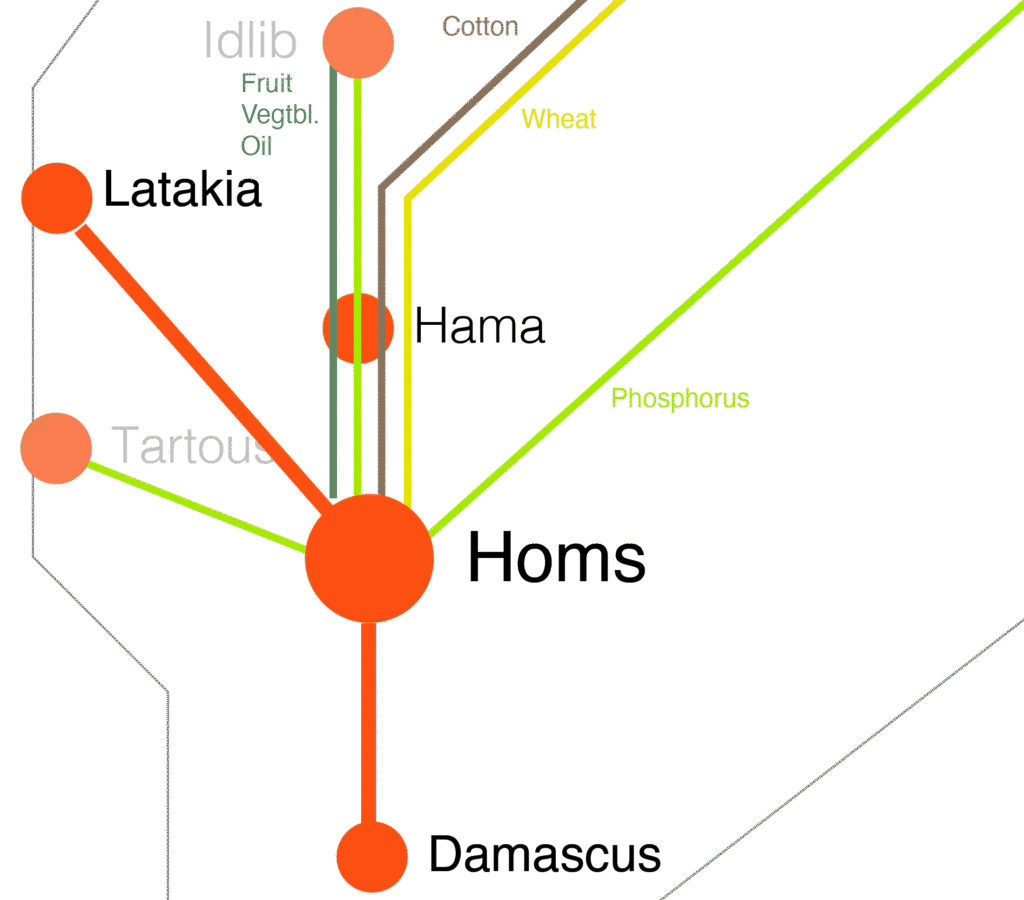
Economic context of Homs with important resources. Cotton brown, Wheat yellow, fruit and vegetable oil dark green, phosphorus caps lock green.
Map of selected resource consumers and producers (in the colour of resource left), strategic locations (light grey) and selected checkpoints (red)
Aside from the political effectiveness of checkpoints in Syria, the geographic placement of Syria’s cities lends itself to the development of checkpoints. The capital, Damascus, is encircled by the Lebanese border to the west and the desert to the east and must rely on domestic produce from the north and imports via ports. While traditionally these ports were under regime control54 (see also our perspective on Harbours), Syria’s sectarian challenges are also most prominent in those areas.
Exploring the evolution of checkpoints
Drawing from a combination of satellite imagery, ground footage, first-hand sources, news reports, and social media posts, we focused on checkpoints anchored along a key logistical route stretching from Latakia to Homs to Damascus and extending towards Beirut.

This composition depicts the spread and persistence of checkpoints along the major economic arteries of Syria from the start of 2011 (which marks the popular uprising against the Assad regime) to the most recent available imagery from June 2024. We located these positions by systematically scanning satellite imagery of major routes connecting Beirut, Damascus, Homs, and Latakia, as well as in Homs itself, which has long been a crucial node in Syria because of its position between regime-controlled areas and industries and rebel-held territory north and east of the city.
Spatial typologies of checkpoints using illustrative case studies
The physical development of checkpoints makes visible the spatiotemporal dimension of regime and paramilitary power across Syria. A single checkpoint could, therefore, trace the evolution and use of this power in a specific site.
During our research, we identified several case studies that could fulfil this aim. Case studies took root for different reasons. At times, checkpoints with abundant ground footage had little information on its operations; others were identifiable by satellite but had a scarcity of ground footage, and lastly, some were referred to in news reports but were not named well enough for us to geographically locate. Our case studies are used to represent different aspects of interest; for example, if they are good examples for illustrating specific operational or material conditions.
Case Studies and Typologies
Operational conditions
Operational conditions outlines the functions of checkpoints beyond their typical uses and looks into economic and military practices that impact human rights, such as freedom of movement. We demonstrate this through three case studies:
- Case study 1: Sugar factory – Economic Control
- Case study 2: Case study 2: Al-Wa’er – a cluster of checkpoints
- Case study 3: Lebanon border crossing – sign of strength
Material conditions
Material conditions parses the infrastructural anatomy of checkpoint and characterises the differences between fixed, flying and hybrid examples:
Spatial Typologies
Finally, we offer a visual glossary that outlines the material components of checkpoints. This database, or inventory, of image classifiers could be used to help detect the features and operations of checkpoints for future investigations.
These spatial tools are a proposed methodology for exploring further how the materiality of checkpoints work in facilitating wealth extraction, exploitation and governance in Syria and potentially other countries. Under each case study, we track the processes and methods used to generate the visualisations and our analysis.
Conclusion
Overall, our research has shown how checkpoints operated as decisive instruments in shaping Syria’s material and political landscape, mediating mobility and access to resources.
We have sought to make visible the infrastructural network of checkpoints in order for future work to consider how domination and extraction are materialised in space through its various reconstructions. This framework – combining spatial analysis, testimonial correlation, and open-source reconstruction – offers a transferable approach for examining similar architectures of control in other conflict settings. We propose these techniques and methodologies can contribute to transitional justice efforts that seek to incorporate unjust enrichment as a statutory remedy for asset recovery.
Future Work
Having proposed the spatial investigation of checkpoints as a methodology, we can begin to speculate about the key actors who might be held accountable for the acts of exploitation that we have presented.
In the absence of a verifiable paper trail or accessible bank statements, direct evidence of those who profit from Syria’s checkpoint economy remains elusive. Where financial records fall silent, the emergence and repetition of key named actors reveals its own pattern and narrative.
Beneficiaries of a War Economy
Through our research, we found numerous instances of financial extortion at checkpoints, which more broadly have terrorised civilians and wreaked havoc on civil society. It is therefore worth asking: Who benefits from all of this? Who pockets the money?
It is worth noting that it is impossible to track the movement of money collected at checkpoints. The limited ground footage we found that shows the exchange of money suggests theat fees taken at checkpoints were in cash. However, in the spirit of the project’s goal in facilitating transitional justice, we looked at how top Assad regime officials – those who handed down orders within government forces – benefited from checkpoints:
Below we have identified a number of top officials who have reportedly benefitted from checkpoints:
1. Saqr Rustom, National Defense Forces
The Harmoon Center for Contemporary Studies (a nonprofit research institution dedicated to examining Syria) has made the case55 that, in some instances, profits from checkpoints incentivised military leadership to provoke continued conflict and mistrust between neighbourhoods along with a sectarian violence. Among the more notorious figures involved in this practice is Saqr Rustom56, who hailed from the Alawite countryside of Homs and who founded the local National Defense Forces (NDF), a pro-regime militia. Several reports from researchers and independent news outlets have linked bombings and NDF violence to Rustom’s “security empire.”
In February 2016, Al-Moldon reported that Rustom wasat least aware of bombings in a government-held neighbourhood of Homs, allegedly to maintain chaos in the region which would allow the NDF to “continue playing its mafia-like security role.” This “mafia-like security role” included extortion, kidnapping, looting, and the operation running of checkpoints –all of which generated revenues amounting to a “financial empire” for Rustom.
2.Abu Ali Khoder or Taher Ali Khoder
The Harmoon Center also pointed57 to top militia leadership directly managing the financial revenue coming from checkpoints. This was the case of Abu Ali Khoder (or Taher Ali Choder)58. After forming a local militia to bolster the efforts of Fourth Division commander Maher Al-Assad, Khoder went on to manage Fourth Division’s revenue streams from its monopoly over Syria, particularly from the hundreds of checkpoints it held across Syria. In August 2023, The Syrian Observer described59 Abu Ali Khodr as maintaining “unparalleled control over all crossings within Syria’s borders,” noting that “the revenue generated through these crossings invariably cascades to individuals wielding significant influence and power.” Furthermore, the money trail goes beyond Khoder himself: The Harmoon Center reported that Abu Ali Khoder, a businessman closely linked to both Rustom and Maher al-Assad, delivered “huge” sums of money via convoy to senior regime figures, including Asma al-Assad. It’s alleged Khodr made these trips up to three times a week.
3. Shafiq Sarem, Airforce Intelligence
In June 2023, the Syrian Observatory for Human Rights reported60 that Airforce Intelligence leadership in Homs had leveraged their control of the city’s northern industrial area to extort factories. At the time, Shafiq Sarem, who had alleged close ties to Maher Al-Assad61, was serving as Brigadier General – this changed later62. The Airforce Intelligence also ran checkpoints at key entryways into the industrial zone, allegedly extorting 500,000 Syrian pounds from each. The Syrian Observatory also alleged that Sarem benefitted personally as well after threatening an owner of a natural marble quarry with closure unless the supplier provided free manufacturing services for his residences63. He was also named in an HRW report on torture in Syria64.
Taken together, this investigation demonstrates how checkpoints do not exist purely as a security apparatus but represent a vast network of profit-driven nodes, cementing their role as a tool of domination and source of wealth extraction, propped up by militia, businessmen and high-ranking government officials.
Our methodology: Exploring the evolution of checkpoints
In this investigation, we could not determine how exact checkpoints functioned in terms of tracing the movement of goods (such as natural resources, trade and humanitarian aid) or as mechanisms of population control using open-source intelligence methodologies and without better connections with civilians on-the-ground. Indeed, checkpoint knowledge can be highly fragmented and due to the heavily militarised nature of checkpoints, this protects them from media presence leading to minimal information about their activities65 and a reliance on anecdotal accounts.
Instead, we focused upon practices of wealth extraction and accumulation occurring at checkpoints. Our hypothesis is that the evolution of a checkpoint’s materiality is linked to the evolution of its economic and strategic value.
We engaged in intricate efforts to discern what they were (both in terms of material formations and operations), where they were, when they appeared, expanded or disappeared and to determine why. However, it quickly became apparent that we could not comprehensively coordinate answers to all questions for all checkpoints.
The materials we have presented are speculative tools for future investigations. They offer a potential springboard for others looking to trace the actors that have exploited and benefited from checkpoints. The materials we have presented may help efforts to analyse the new role (or lack thereof) checkpoints play during the country’s current post-war transition, considering:
“Governance rarely vanishes; it reconfigures. This reconfiguration does not necessarily involve new institutions or ideologies, but new terrains and techniques of control—often embedded in the everyday… the state is not simply what is written in law, but what is performed, perceived, and contested in the intimate spaces of daily life. It is precisely in these marginal and crisis-afflicted zones that the state may be most acutely felt.”66
Open Questions
Owing to the limited release of high-resolution satellite imagery since December 2024, the status of many of the 46 checkpoints identified in this study remains indeterminate. Our current dataset confirms that 16 of these were dismantled prior to June 2024, with 14 located within Homs. Future phases of this investigation could extend beyond Homs to identify potential continuities in checkpoint operations and their evolving spatial and economic logics.
Whilst our investigation is bounded from 2011-24, we acknowledge that power structures may endure into the present when entrenched and useful. After the fall of Assad’s regime at the end of 2024, the al-Sharaa administration has been working to rebuild the economy. While borders have reopened and some a decade-old checkpoints were closed67 compared to 10 years ago68, the security situation69 70 may still justify operating some checkpoints, which may still be used for profiteering. The checkpoint geography of Syria is thus highly likely to enter new iterations that will continue to reflect, adapt to and even influence the country’s economies, geographical landscape and power relations. This builds a case for continuing to investigate checkpoints as sites that make visible Syria’s complex (post-)war-economy.
- Rediet Adane Derebe, Governing by Checkpoints: Everyday Mobility and Control in Wartime Amhara, Kulturní Studia / Cultural Studies 24 (2022): 119-137. ↩︎
- Shuaier Liu, Rebuilding Syria: Hopes and Hurdles. The Next Century Foundation, September 26, 2025. ↩︎
- “Syrian Civil War.” Wikipedia, November 8, 2025. ↩︎
- Dylan O’Driscoll, Omran Omer Ali, and Remonda Armia, “Checkpoints, Competing ‘Sovereignties’, and Everyday Life in Iraqm” Political Geography 115 (November 2024). ↩︎
- Syria Community Walk on Wayback Machine ↩︎
- “SOHR Statistics.” Syria HR, Accessed November 9, 2025. ↩︎
- United Nations Development Programme. The Impact of the Conflict in Syria. United Nations Development Programme, February 20, 2025. ↩︎
- According to J Yazigi in May Thet Niang. “The War Economy of Syria.” Michigan Journal of Economics, April 17, 2024. ↩︎
- “International Sanctions against Syria.” Wikipedia, November 9, 2025. ↩︎
- Niang, “The War Economy of Syria.” ↩︎
- Will Todman, Sieges in Syria: Profiteering from Misery. Middle East Institute, 2016. ↩︎
- Kristin V Monroe, “Driving Across the Warscape: Syrian Cross-Border Taxi Drivers and the Politics of Mobility,” Environment and Planning C: Politics and Space 41.7 (2023): 1374-1390. ↩︎
- Orwa Ajjoub, “Fear of Checkpoints Spreads in Damascus,” The New Humanitarian, December 16, 2015. ↩︎
- Syrian Network for Human Rights. “At least 2,623 Arbitrary Detentions Documented in 2024, Including 349 in December.” Syrian Network for Human Rights, January 4, 2025. ↩︎
- Landinfo. Office of the Commissioner General for Refugees and Stateless Persons. Reactions against Deserters and Draft Evaders in Syria. 2018. ↩︎
- Justin Schon, “The Centrality of Checkpoints for Civilians During conflict,” Civil Wars 18.3 (2016): 281-310. ↩︎
- Nedaa Post. “نهاية مأساوية لشابين في حمص رفضا منح ضابط في النظام السوري شقة سكنية.” Nedaa Post, June 8, 2023. ↩︎
- Schuppli, Susan. MATERIAL WITNESS: Media, Forensics, Evidence. The MIT Press, 2020. ↩︎
- Salwa Ismail, The Rule of Violence: Subjectivity, Memory and Government in Syria, Cambridge University Press, 2018. ↩︎
- Leïla Vignal, “The Changing Borders and Borderlands of Syria in a Time of Conflict,” International Affairs 93.4 (2017): 809-827. ↩︎
- Lina Khatib, “Power Dynamics of Cross-Border Conflict in Lebanon and Syria,” Border Crossing 14.2 (2024): 87. ↩︎
- Aawsat. “هشاشة الحدود السورية ترسم علاقات شائكة مع دول الجوار.” Aawsat, April 26, 2025. ↩︎
- Hashem Osseiran, “How Sectarianism Can Help Explain the Syrian War,”The New Humanitarian, March 6, 2018. ↩︎
- Lina Khatib and Lina Sinjab. Syria’s Transactional State: How the Conflict Changed the Syrian State’s Exercise of Power. Chatham House, October 2018. ↩︎
- UN-Habitat. City Profile Homs: Multi-Sector Assessment. SDC, 2014. ↩︎
- Hassan, Hassan, and Michael Weiss, “The Backstory Behind the Fall of Aleppo,” New Lines Magazine, December 17, 2024. ↩︎
- UN Habitat, City Profile of Homs. ↩︎
- Syrian Observatory for Human Rights (SNHR). “Fourth Division Confiscates Diesel Loaded on Tankers and Goods Waggon near Al-Qatifah Bridge.” Syrian Observatory for Human Rights, October 31, 2022. ↩︎
- Said Masry, Mohammed, Hourani, Rashid, Almgarbel, Abdulazim, and Assi, Abdulwahhab. Power in the Shadows: Syria’s Fourth Division, Jusoor for Studies, 2024. ↩︎
- SNHR, “Fourth Division Confiscates Diesel.” ↩︎
- Syrian Observatory for Human Rights. “‘Law of Jungle’. ‘4th Division’ Checkpoints Blackmail Civilians Coming from Arab Countries by Confiscating Their Money and Stealing Their Luggage.” Syrian Observatory for Human Rights, May 23, 2022. ↩︎
- Meshmesh, Agid. “Fourth Division devises new formula to collect taxes in Syria.” North Press Agency, December 27, 2023. ↩︎
- Homs Chamber of Industry, “عدم توفر الأقطان بشكل كاف ورداءة الكميات القليلة الموجودة وغلاء أسعارها تتسبب بشلل للصناعة النسيجية السورية,” Homs Chamber of Industry, November 24, 2023. ↩︎
- Syria TV, “توقف معامل السكر والخميرة والكحول والزيت والصابون في حمص,” Syria TV, August 12, 2023. ↩︎
- Rafah al-Allouni and Manar Salameh. “Agricultural Revival in Latakia’s Jabal al-Akrad as Displaced Families Return Home.” Syrian Arab News Agency, August 8, 2025. ↩︎
- Alsouria, “دوار الشمس.. زراعة “استراتيجية” تجد طريقها مجدداً إلى إدلب,” Alsouria, September 28, 2022. ↩︎
- Kenan Metri, “ها نحن نسمعها..إحدى شركات قطاعنا العام الحمصي رابحة,” Esyria, February 24, 2008. ↩︎
- Syria TV, “الشوندر السكري في سوريا.. محصول استراتيجي حوّله النظام إلى علف للحيوانات”, Syria TV, December 21, 2023. ↩︎
- North Press Agency. “الشوندر السكري من أهم الزراعات إلى علف للماشية في سهل الغاب.” North Press Agency, January 18, 2022. ↩︎
- Al-Araby, “النظام السوري يعلن مصنع سكر حمص غير قابل للإنتاج الصناعي مجدداً,“Al-Araby / The New Arab, March 7, 2022. ↩︎
- Al-Estiklal, “Tarif Al-Akhras, Assad’s Businessman Who Was Excluded From Britain’s Sanctions,“ Al-Estiklal, August 26, 2021. ↩︎
- Syrian Arab News Agency (SANA), “مصادرة خمسة أطنان من السكر معدة للتهريب بحمص“, Syrian Arab News Agency (SANA) Archive, May 5, 2020. ↩︎
- The Syrian Observer, “The Regime’s Eye on Its Supporters Wealth: Tarif al-Akhras as a Case Study.” The Syrian Observer, August 8, 2024. ↩︎
- The New Arab Staff. “Syria State Media Reports Israeli Attack on Homs Province.” The New Arab, October 10, 2024. ↩︎
- The Syrian Observer, “Iran’s ‘Gift’ to Syria Comes to an End: Saipa Car Factory Shuts Down,” The Syrian Observer, November 19, 2024. ↩︎
- Syrian Observatory for Human Rights, “Fourth Division Confiscates Diesel.” ↩︎
- Al-Araby / The New Arab. “Revealed: Inside the Murky Supply Chain Bringing Syrian Phosphates into Europe.” Al-Araby / The New Arab, June 30, 2022. ↩︎
- Al-Modon. “Fertilizer Company Contract Cancelled: Russian Grudges.” The Syrian Observer, December 11, 2023. ↩︎
- Syrian Observatory for Human Rights. “بتهم الفساد واختلاس المال العام.. إدارة المخابرات العامة تلاحق مدير عام شركة الجيولوجيا وتعتقل عددا من الموظفين في حمص,” Syrian Observatory for Human Rights, September 7, 2023. ↩︎
- France 24. “In Syria, the Fourth Division of Maher al-Assad’s Control Over the Country’s Wealth.” France 24, March 3, 2025. ↩︎
- Political Keys. “خاص | ضغط روسي ينهي تكليف اللواء “شفيق صارم” من إدارة المخابرات الجوية… و”بوليتكال كيز” تكشف الأسباب.“ Political Keys, January 30, 2024. ↩︎
- Enab Baladi. فرزات للزيوت” تعتزم إعادة افتتاح معملها في سوريا.“ Enab Baladi, May 19, 2025. ↩︎
- Enab Baladi. “الحبوب السورية: استلام أكثر من 212 ألف طن من القمح لموسم 2025,” Yalla Syria, June 24, 2025. ↩︎
- International Institute for Strategic Studies, “Tartus Port and Syria’s New Geo-Economic Strategy,” IISS Online Analysis, July 3, 2025. ↩︎
- Wajih Hadaad, Replacing the Old Business Elite With the New War Profiteers in Syria, Harmoon Center for Contemporary Studies, 2022. ↩︎
- “Saqer Asad Rustom.” OpenSanctions, last modified September 23, 2025. ↩︎
- Hadaad, “Replacing the Old Business Elite.” ↩︎
- “Khader Ali Taher,” OpenSanctions, November 3, 2025. ↩︎
- The Syrian Observer. “‘Abu Ali Khodr’ – Unveiling the Enigmatic Power Player in Syria’s Complex Landscape.” The Syrian Observer, August 28, 2023. ↩︎
- Syrian Observatory for Human Rights. “بذرائع منها عدم وجود الرخص.. رئيس فرع المخابرات الجوية بحمص يفرض إتاوات على المواطنين تعود عليه بملايين الليرا”ت السورية شهرياً.” Syrian Observatory for Human Rights, June 17, 2023. ↩︎
- Syrian Observatory for Human Rights, “بتهم الفساد واختلاس المال العام.. إدارة المخابرات العامة تلاحق مدير عام شركة الجيولوجيا وتعتقل عددا من الموظفين في حمص.” ↩︎
- Political Keys, خاص | ضغط روسي ينهي تكليف اللواء “شفيق صارم” من إدارة المخابرات الجوية… و”بوليتكال كيز” تكشف الأسباب.“ ↩︎
- Syrian Observatory for Human Rights. “بذرائع منها عدم وجود الرخص.. رئيس فرع المخابرات الجوية بحمص يفرض إتاوات على المواطنين تعود عليه بملايين الليرا”ت السورية شهرياً.” Syrian Observatory for Human Rights, June 17, 2023. ↩︎
- Human Rights Watch. “Torture Archipelago: Arbitrary Arrests, Torture and Enforced Disappearances in Syria’s Underground Prisons since March 2011.” Human Rights Watch, July 3, 2012. ↩︎
- Stathis Kalyvas, “The Urban Bias in Research on Civil Wars.” Security Studies 13, no. 2 (2004). ↩︎
- Derebe, “Governing by Checkpoints.” ↩︎
- Leila Fadel, “On the Road From Beirut to Damascus – People Find Their Footing in a New Syria,” NPR, December 12, 2024. ↩︎
- Lava Selo, “The Deadly Checkpoint That Divides Syria’s Biggest City,” NPR, September 6, 2013. ↩︎
- William Christou, “Border Wars: Syria’s New Authorities Grapple with Lebanese Smugglers,” The Guardian, April 1, 2025. ↩︎
- Al Jazeera Media Network, “One Killed, Several Injured in Syrian Army, SDF Clashes in Aleppo: Reports,” Al Jazeera, October 7, 2025. ↩︎