Flows of Power, Cargoes of Control
“Logistics discovers too late that the sea has no back door.”1
In the current liminal time-space of Syria’s post-Assad governance, much remains uncertain about the future awaiting Syrian people, beyond their urgent needs to sustain themselves and rebuild their country after generations of destruction and repression.
The material goods required for this reconstruction – and the trade logistics enabling their circulation among individuals, corporations and state entities – provide a parallel view of Syria’s political terrain and the material conditions shaping daily life.
Analysing Syria’s material flows provides an opportunity to uncover the ongoing cycles of profiteering that have contributed to the devastation and the dispossession of Syria’s land and people. Such analysis can also help advance the pursuit of transitional justice and corporate accountability in Syria.
We move beyond inanimate and impersonal conceptions of materials, logistics and ports – instead approaching trade as a dynamic and relational process intrinsically linked to the shifting needs and capacities of people, landscapes, natural resources and the interests of political and economic actors.
We build upon existing theoretical discussions on the necessity of an emergent human geography approach to port and port city studies2, as well as Stephen Harney’s and Fred Moten’s rejection of the mainstream conceptualisation of logistics as an inherently efficient, logical and just movement of goods and material3. When logistics becomes a process through which dispossession and wealth accumulation are concealed, occasional ruptures in typically covert logistical operations can become a sensor through which unjust actions can be identified and brought to light.
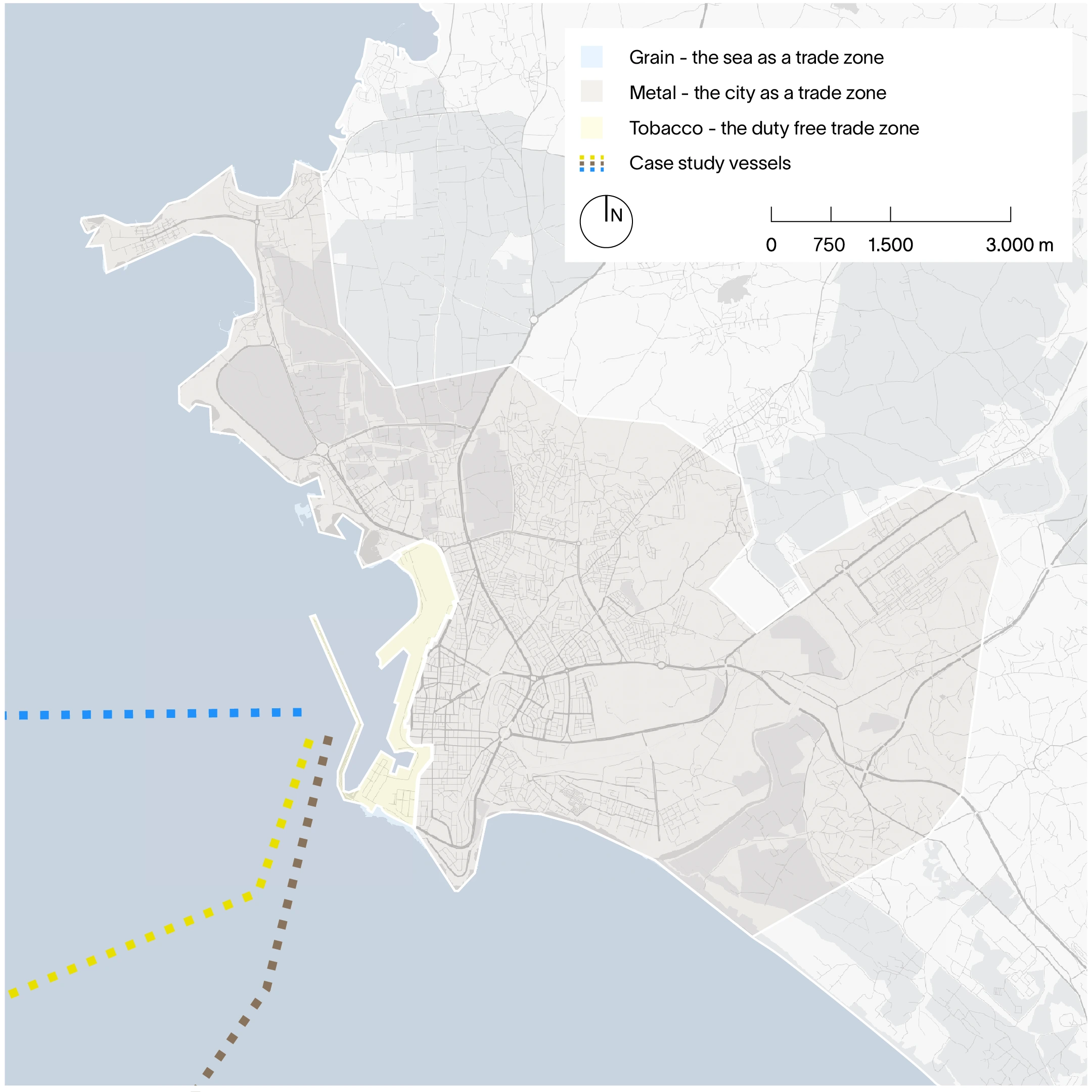
Our study examines three materials as observed at key points of contact in the liminal port-city of Latakia:
We understand Latakia as a porous membrane that regulates the flow of goods into, out of, and across Syria, its permeability shaped by networks of actors who determine what may pass.
Building on this conception, our analysis of three incidents involving material flows in Syria employs open-source intelligence methods to uncover the often-subliminal dynamics embedded within shipments, trade deals and production processes: international grain imports; the internal-external economies of Syria related to metal in a time of reconstruction; and tobacco monopolisation, all of which are critical to everyday life in Syria.
4 5 6 7 8 9 10 11 12 13 14 15 16 17 18 19 20 21 22
Background of Port Ownership
In establishing the port-city of Latakia as a liminal, membrane-like space from where actors permit the circulation of goods, we consider it essential to first outline an overview of the ownership and governance of the Port of Latakia in the timeline below.
The port’s evolving ownership and management structures enable a dialogue between the logistical incidents being studied as they relate to the structural dynamics of control, sovereignty and economic influence that determine the port’s permeability.
Outlining the relational networks behind the ownership and operations of Latakia Port goes beyond understanding port administration. These relationships function as an epistemic backdrop for interpreting the sociopolitical processes governing the permitted logistical movement of traded materials, allowing us to highlight broader correlations between our selected case studies and the power structures that direct their movement within and outside of Syria.
Latakia Port General Company (LPGC) established.
The LPGC is founded under Decree No. 38 as a joint public-private company under the Ministry of Economy, to develop and invest in the seaport infrastructure at Latakia.4
Assad regime.
LPGC placed under Ministry of Transport
LPGC is re-affiliated to the Ministry of Transport of the Syrian Arab Republic, marking an administrative shift in port governance.5
LPGC becomes public-sector company.
Under Law No. 17 of 1982 LPGC is converted into a fully public-sector enterprise, consolidating state ownership of port operations.6
Al-Sahel Customs Clearance Co. founded
The Al‑Sahel Customs Clearance Company is licensed; affiliated to the network of Jamil al‑Assad; sources link it to operations at Latakia Port customs, informal levies and smuggling facilitation.7
Sulayman Balush tenure as Port Director
Sulayman Balush is appointed General Director of LPGC in 2007 (renewed to 2010 despite retirement age) and is removed in 2011 by Prime Minister Adel Safar for major violations; his prior curriculum linked him to the Investment Directorate of the port and the influence of the Fourth Division over key appointments is documented.8
Latakia International Container Terminal (LITC) created
LICT is established as a joint venture between Terminal Link (51 %) and Souria Holding (49 %). Terminal link is owned by CMA CGM, the second largest shipping company in the world and whose main owners, the Saade family, are of Syrian descent. Souria Holding is a large holding company established in 2007 and grouping some 25 Syrian shareholders.9
Latakia International Container Terminal (LITC) established.
LICT is established as a joint venture between Terminal Link (51 %) and Souria Holding (49 %). Terminal link is owned by CMA-CGM, the third largest shipping company in the world and whose main owners, the Saade family, are of Syrian descent. Souria Holding is a large holding company established in 2007 and grouping some 25 Syrian shareholders.10
CMA CGM suspends Iran shipments
The French shipping group CMA-CGM announces suspension of all shipments to Iran as extra precaution due to U.S. sanction threats; Syria operations continue for the moment.11
Assad-linked networks consolidate control at port
Networks affiliated with Jamil al-Assad and the Fourth Division expand dominance over customs and logistics operations at Latakia Port, reportedly imposing informal levies, controlling clearance, and facilitating smuggling.12
the Maritime Workers Union opposes LICT contract renewal
The Maritime Workers Union (Syria) publicly calls on the government not to renew LICT’s contract, blaming insufficient infrastructure investment and corruption; indicating internal regime resistance.14
CMA CGM/LICT contract extended.
The contract with LICT/CMA-CGM is extended by five years; CMA Terminals reportedly gains 99 % ownership of the terminal.15
CMA CGM acquires full LICT ownership
Souria Holding reportedly sells its stake; CMA-CGM, via CMA Terminals, becomes sole owner of LICT.16
Vallis Services opens office in Latakia
The British inspection firm Vallis Services Limited starts operations in Syria with a representative office in Latakia for ship cargo inspection and monitoring; links to WFP and humanitarian clients noted.17
Maersk exits Syria
The Danish shipping giant Maersk announces it will no longer serve any Syrian destinations; the Maersk Narmada becomes the last vessel to dock in Latakia.18
CMA CGM contract renewed after 1 year negotiations
After protracted talks the contract with LICT is renewed; container volumes at Latakia Port reported at ~105,000 TEUs in 2023 (less than one-fifth of 2010 levels).19
Fall of Assad regime.
Beginning of governance transition under Ahmad al-Sharaa.
The General Authority for Land and Sea Borders (GALSB) established
The GALSB is created to unify customs, ports and free-zone administration under a centralized structure.20
CMA CGM contract renewed fo 30 years.
The contract with CMA-CGM is renewed under the new transitional government; described as the first foreign investment deal after the regime change.21
Second phase agreement with CMA CGM announced
CMA-CGM begins the second phase of its agreement with GALSB: construction of a new dock at Latakia, development of dry-ports and goods transport via Damascus International Airport.22
- Harney et al., The Undercommons, 2013. ↩︎
- Ng et al., “Port Geography at the Crossroads with Human Geography,” 2014. ↩︎
- Harney et al., The Undercommons, 2013. ↩︎
- Lattakia Port Company. n.d. “About – Lattakia Port Company.” ↩︎
- Lattakia Port Company. n.d. “About – Lattakia Port Company.” ↩︎
- Lattakia Port Company. n.d. “About – Lattakia Port Company.” ↩︎
- Eqtsad, “Jamil al-Assad, the King of the Crossings,” ↩︎
- Aldassouky, The Economic Networks of the Fourth Division, 2020. ↩︎
- The Syria Report. 2024. “Lattakia International Container Terminal LLC.” ↩︎
- The Syria Report. 2024. “Lattakia International Container Terminal LLC.” ↩︎
- The Syria Report. 2024. “CMA CGM Extends Contract to Manage Lattakia Port.” ↩︎
- Aldassouky, The Economic Networks of the Fourth Division, 2020. ↩︎
- OpenSanctions. n.d. “Lattakia Port General Company (LPGC).” ↩︎
- The Syria Report, “Iran Eyeing Control of Lattakia Port,” 2019. ↩︎
- The Syria Report, “Iran Eyeing Control of Lattakia Port,” 2019. ↩︎
- The Syria Report. 2024. “CMA CGM Extends Contract to Manage Lattakia Port.” ↩︎
- The Syria Report, British Company Opens Office in Syria, 2023. ↩︎
- The Syria Report. 2023. “Maersk Claims Sanctions Behind Decision to Withdraw from Syria.” ↩︎
- The Syria Report. 2024. “CMA CGM Extends Contract to Manage Lattakia Port.” ↩︎
- The Syria Report. 2025. “Explained: Free Zones in Syria.” ↩︎
- The Syria Report. 2025. “Despite Fragile Transition, Sharaa Opens Up Syria to Foreign Companies.” ↩︎
- The Syria Report. 2025. “Western Companies Intensify Investment Drive in Syria.” ↩︎