Development
Victory Boulevard
In June 2025, Al-Qarabis neighbourhood woke up to billboards announcing the proposed ‘Victory (Al-Nasr) Boulevard’ development1. The neighbourhood is situated in the city of Homs and sustained heavy destruction between May 2011 and May 2014 during Assad’s rule over Syria. Today, the renders exhibited on these billboards show residential areas, touristic attractions, and an economic zone located at the North Western part of Homs City. Following this announcement2, documented public demonstrations erupted in Al-Qarabees neighbourhood on 16 August 2025 with protesters citing similarities to the ‘Homs Dream’ project announced in 2010.
Development is a powerful rhetorical device for leaders in zones of reconstruction. Development is often uncritically posited as an absolute good, associated with propelling a nation forward towards modernisation and prosperity. In his first presidential speech, al-Sharaa proclaimed that ‘building the homeland is the responsibility of all of us, and this is a call to all Syrians to participate in building a new homeland, in which there is rule through justice and consultation’3. This statement appeals to the notion of development as an unfolding practice, a way of unleashing the unbridled opportunities captured within a nation devastated by 14 years of war and bombardment. Development suggests a new beginning, the process of creating possession. ‘Victory Boulevard’ represents a place of victory following destruction, a place of opportunity following its ruin. But who gets the spillage, and who gets the gains?
Development also becomes a means to make visible that which is not. Developing an image makes visible the latent imagery hidden within a film, developing a city makes material the flows of financial transactions and power into the roads, walls and buildings.
Through tracing the ‘development’ of real estate projects, we visualise the opacity in the deals and processes mediating reconstruction in Syria, and in the specific sites in Homs, the focus of this investigation.
If to develop is to create the new, to unleash the potential of a city, then through this investigation of the life cycle of the Homs Dream project and its successor, Victory Boulevard, we can problematise the notion and praxis of development. While Al-Sharaa promised a ‘new homeland,’ this investigation reveals that processes used to secure real estate projects in Homs have continuity with those developed by the old regime, and continues to operate through the same logics of opacity.
This investigation finds that Victory Boulevard is a continuation of the past Homs Dreams project, as analysed through advertising videos and renders that show the parallels in location of the first-phase boundary of the Homs Dream plan. Given the above, it raises the question of why construction is prioritized on undamaged land instead of rebuilding the many destroyed homes in Homs.
Our investigation employs spatial analysis combined with Open Source Intelligence, such as constructing a chronological timeline, cartographic study, synchronising video footage, and incorporating testimony from a Homs-based interlocutor to shed light on some aspects of Homs development projects.
Marota City: A Mirage of Development
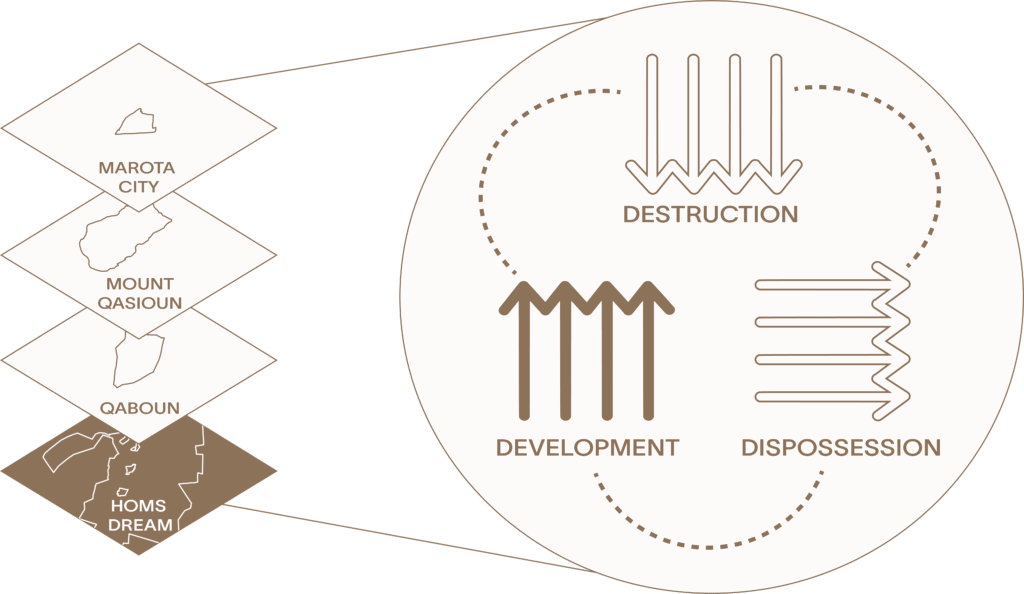
Marota City was a key node to understand how development was weaponised as a means of urban planning. Marota, meaning ‘the nation’, or ‘sovereignty’, was introduced in 2012, it was poised to be an emblem of reconstruction, supposedly providing 110,000 job opportunities4, and 12,000 housing units5. While construction did not begin until 2016, the completion of the ‘development’ project was made impossible without the other two key mechanisms of dispossession and destruction. While Marota was framed to become a ‘luxury megacity’ by the Assad regime, in its phase of development (2009 to 2013) residents were evicted from the Basateen al-Razi neighbourhood for its vision to be developed. Development through dispossession was formalised through Decree 66 in 2012 and then exacerbated in 2018 through Law No. 10 which gave the administration the power to repossess property from those without formal registration documents. The introduction of Law 10 made it challenging for millions of displaced Syrians and refugees to reclaim their homes, as many were forced to flee without the necessary property ownership documents6.
While the development of Marota City is ongoing, instead of providing social and economic advancement for the neighbourhood, it became a means of enriching those closely affiliated with the regime. Key figures within the Assad regime, including Samer Foz, Hussam Katerji, and Mohammad Hamsho, profited from the ‘development’ of Marota City through obscure financial flows and secured lucrative contracts and investment opportunities. This occurred in parallel with the displacement of 7,500 families from Basateen al-Razi. This history led us to investigate if similar processes of opacity were occurring in other real estate development projects across Syria.
Homs as a Locus of Proclaimed Development
Homs occupies a strategic location in central Syria, serving as a key junction connecting Aleppo to Damascus and linking the ports of Tartous and Latakia with the Syrian interior, covering an area of approximately four million hectares in total7. Prior to the war, Homs was a pluralistic city with a majority Sunni demographic and significant minorities of Christians and Alawites8.

In 2011, Homs was nicknamed the ‘capital of revolution’ after widespread demonstrations swept through the city centre near the Khalid bin al-Waleed Mosque and clock tower9. In retaliation to the anti-government protests, pro-regime militias were sent in to quell dissent. The government laid siege on Homs between 2011 and 2014 and in the aftermath, scholar Ammar Azzouz argued that ‘everyday life in Homs has been radically reshaped by the destruction of the built environment’10.
Today, the development of Homs has become an important discursive device for the new government as a break from the past. Located at the intersection of transportation routes, such as M5 highways, Homs is important in regards to logistics, trade, and military mobility during Assad’s regime11. Homs is also connected several cities such as Damascus, Aleppo, and Latakia, and this geographical proximity made the city as important hub which was essential for development in Syria12. During the post-Assad regime, the attempt to ‘rebuild the city that has been bombarded’13 through the urban redevelopment agenda, became the reconstruction priority in Syria, including Homs.14
Development thus became the methodology by which we assessed the real estate projects proposed in Homs from 2008 to 2025.
However, as demonstrated through the case of Marota City, the operative mode of development is incomplete without the mechanisms of dispossession and destruction. Development thus also becomes a point of departure and a point of contention in this study. Through the investigation of Homs Dream and Victory Boulevard, we ask who do these development projects serve – are these projects realising the promise of a ‘new homeland,’ and whose homeland does it create?

Homs Dream
Homs Dream (حلم حمص), was first made public in 2005 and ‘has been shrouded in mystery’ ever since15. It lacked consultation with the public, transparency around how it would be developed and who it would serve. Homs Dream was simply one of many reconstruction projects planned around Syria by the former regime. While these development plans varied in location, intent and propaganda claims, through comparative analysis of Marota City and Homs Dream we could see that there were similar patterns of dispossession and destruction inherent to the development.

We obtained two videos of the Homs Dream project published in 2010, tracing these videos to a visual production company based in the United Arab Emirates, called Artware1617. We analysed these two videos, and extracted frames showing 5 renders of 6 major development areas under the Homs Dream Project. Subsequently, we were able to match these frames through a custom interactive browser based tool that allowed us to geolocate six major development areas under Homs Dream. These areas are: Al-Hal Market and the textile company area (234,270 square meters), the people’s park area (492,145 square meters), the Mills and Old Karajat Area (192,937 square meters), the IPC Oil Transport Project land area located near the train station (292,650 square meters), the Al-A’deen Camp for Palestinian refugees south of Homs University (455,344 square meters), and finally the city centre area (262,696 square meters).
The total area of these development sites is around 1,930,042 square meters. These major development areas are concentrated at the major roads branching from the M5 highway from Aleppo towards Damascus.
In terms of land use, all the six zones we identified previously by matching the commercial renders were located within the first phase boundary of the Homs Dream plan. The Hal Market area along with the textile factory zone are classified as stateland. However, the area used included orchards and agricultural areas before they were seized from their original owners in the mid 70s18.
The Victory Park area, previously known as people’s park, was seized from its owners before the launch of the Homs Dream Project19. In exchange, the owners were given stock in a limited company. The Homs Dream project never materialized.


Renders over the Rubbles / An image of a City
The Governor of Homs, Eyad Ghazal, commissioned an engineering office to create a comprehensive study for the development of Homs Dream in 200520. Residents at the time didn’t yet know what they would face in the upcoming years following the publication of the study. The study led to a master plan of Ghazal’s vision for his governorate: a major construction project consisting of residential, economic and touristic zones across nine areas of Homs. Rastan, Tal Kalakh, Houla, Qusayr, Hassia, Wadai, Mukhram, the northern region, Palmyra, and the so-called ‘Greater Homs’21.
Ghazal’s vision of Homs seemed to be one of relentless urban redevelopment. By 2010, growing numbers of Homs residents accused Governor Eyad Ghazal of using the ‘Homs Dream’ project to justify the expropriation of working-class neighbourhoods and informal settlements under the guise of modernisation. In early 2011, protests in Homs against the regime called for the removal of Eyad Ghazal as governer22. Residents in the Sunni majority Homs argued that Homs Dream, or ‘Homs Nightmare’ as it was colloquially called, was designed to reengineer the demographic makeup of the city23, as the Alawite majority areas remained untouched by the plans. Local resistance sharpened, as many residents were displaced from the densely populated areas like Baba Amr, Jobar and Kafr Aya24.
War, Siege and Deliberate Civil Destruction
In 2011, resistance to the Governor’s agenda blended into broader anti-regime sentiment. Early in the revolution, Eyad Ghazal was removed from his position by Assad and fled from Syria as anti-government protests erupted in Homs25. The Syrian Armed Forces laid siege to neighbourhoods correlating with those destined for redevelopment under the Homs Dream plans26. Baba Amr and the Old City were two neighbourhoods amongst others to be razed to the ground between 2012 and 2014. By the time the final evacuation deals were brokered in 201427, entire districts once listed in Ghazal’s urban vision had been bombed to rubble, indicating that ‘bombings [were] being used as a planning tool’28.

Analysis of damage data on the bombing of Homs illustrates a pattern: Areas of severe shelling and high damage levels predominantly matched with areas of informal housing. Activists and residents of Homs made the claim that the Assad regime was potentially using the destruction of physical infrastructure as a strategic tool to redevelop the city29. By June 2014, the UN habitat assessments revealed that only ‘100 total residents from the besieged areas had not been displaced.’ Residents faced bureaucratic and administrative barriers supported by police and military infrastructures to visit their destroyed homes and retrieve belongings30. Many former residents were unable to return to their homes, establishing a foundation for the potential of a new Homs Dream.
Following population transfers out of Homs, plans to redevelop the city persisted. Consistent with Homs Dream, the Assad regime passed a measure to rebuild Baba Amr31. Redevelopment of the city without a means to repatriate those who lost their homes and land supported the claims of residents that the regime was continuing to manipulate the city’s demographic through the destruction of physical infrastructure. From 2008 to 2010 ‘slow violence’32 of frazed through Baba Amr as building by building was gradually demolished. This massively escalated following the siege in 2011 and slow demolition was replaced with bombardment. In 2016, only 3000 of 80,000 residents returned to Baba Amr due to massive destruction, as reported by United Nations High Commissioner for Refugees33. Despite the destruction of large swathes of Homs, renders of the Homs Dream project in 2014 demonstrated that the plans remained largely unchanged rather than focusing on the areas most damaged by the siege.
Although no construction work ever began to realise Homs Dream, the regime’s actions likely formed a decade-long history of destruction through the facade of development. In at least one area, the Al Masabegh Site, this history might live on.
Victory Boulevard and the Legacy of Homs Dream
Memories of Homs Dream resurfaced as the billboard renders of June 2025 also illustrate the adjacent Al Masabegh site, which was a central feature of Assad’s plans in the city34.
The 190,000 square meters Al Masabegh site is one among multiple future construction areas of Victory Boulevard. Victory boulevard covers 700,000 square meters35 of proposed ‘reconstruction’ in the middle of Homs, with an estimated cost of 900 million US dollars. On the billboards, Victory Boulevard is promoted as an integrated real estate and commercial development project. Included is the rehabilitation of Al-Nasr park – a green area that covers half of the area. The project plans allege that the development project will create 4,500 flats in modern housing and build infrastructural networks36. The billboards, advertisements and social media posts of the project seem to establish the image of a ‘modern suburb’ in Homs.


By analysing the previously mentioned promotional videos comparing Homs Dream to Victory Boulevard, we evidenced parallels between multiple buildings and development complexes. This presents the possible continuity between the endeavours to redevelop Homs, enduring throughout the Assad regime to this new transitional stage. Especially, due to the fact that the project shares the same plot to the past Homs Dream development.37
A consistent feature of the billboards rendering Victory Boulevard was the name and logo of the developer: Al Omran Real Estate and Development Company. First, it seemed unclear why a nascent firm would be commissioned to develop a project at the scale of Victory Boulevard. Their Syrian website is still partially under construction38, their Kuwaiti website is inaccessible39, and their social media presence is in its infancy. With no former projects and likely no business connections to Syria, it’s remains unclear how Al Omran obtained the commission by the Homs Governorate.
A potential link could be Al Omran’s CEO – Rifai Hammada. The spanish-saudi businessman and engineer is familiar with large real estate development projects through his business empire. In 2008, Hammada became the Chief Executive Officer of Hesco Engineering Services40. The company was founded in 1976 and reportedly has between just under 1500 employees and developed projects in Madrid, Dubai and New Delhi41.

According to different media reports, Hammada met with Syria’s new President Ahmed al-Sharaa on multiple occasions4243. Hesco was also listed as one of the major donors to the Syrian Development Fund in October 202544, donating USD250,000. Just days later, their listing disappeared from the website. Until publication, it remained unclear how the connection between the businessman and the President was established.
While Hesco is a known international development firm, many details about Al Omran Real Estate and Development company are clouded. Not much is known about Al Omran in Syria or Kuwait, where the Kuwaiti branch of the company has been active since the early 2000s. Multiple sources, among them the Arabic business register page “Manhom”, list Al Omran as a subsidiary of the Kuwait Real Estate Company45. A tender for this project was not made public and it is unclear how Al Omran received the contract, the reasons for this remain unclear.
In August 2025, a few details of the project were finally established in a press conference led by representatives of the Homs Governorate and Rifai Abbara Hammada46. The Governor of Homs, Dr. Abdul Rahman Al-Ama, and Rifai Hammada sat side-by-side to announce that fair compensation would be paid to residents affected by the project. Although the Homs Governorate’s official website said that compensation is the “main pillar of the implementation of Al-Nasr Boulevard without any exclusion or neglect”47, a local news outlet reported that people would not be returned to their original homes due to major reconstruction changes48. Instead, they would be relocated to smaller residences in the Al-Masbagh area, about 900 meters away, with replacement homes only 65 percent the size of their originals without compensation for the remaining area49. The assistant governor dismissed these claims as rumours, stating that relocation to Al-Masbagh was voluntary and that residents could return after construction was completed50.
The concerns of evictions from homes are rooted in historical experiences of dispossession. Through Law 10 (2018), the regime gave a notice period for occupants to submit deeds and leases documents to prove the property rights51. In 2013, a short video emerged showing fire and flames spreading across the City Council building, where Housing, Land, and Property (HLP) records were kept – believed to be a deliberate act to destroy housing ownership documents52. It made land repatriation extremely complicated, as the regime would reject the right to property or financial compensation without the ‘proper’ documents53.
While dispossessioned occurred through legal measures, residents are also continuing to be financially displaced through being priced out of Homs. Properties being listed in the IPC district of Homs range from USD40,000 to USD100,00054. Residents have complained that these prices are completely unaffordable, with average monthly salaries being around USD25 a month.


Situated division of the speculated family owned land in the area of the Victory Park in Homs.
The press conference also revealed that Victory Boulevard could be potentially financed by private banks such as Al Baraka Bank, National Islamic Bank Syria, International Islamic Bank. Prior to the conference, the new Syrian government announced the decision to prioritise Islamic Bankings, Cham Bank, Syrian International Islamic Bank (SIIB), Al Baraka Bank Syria, and National Islamic Bank (NIB). These banks have been central to financing the new government’s reconstruction projects across Syria.55 They were also key financing institutions for projects under Assad’s regime56, for instance, Al Baraka Bank Syria and SIIB that are both involved in providing private loans for the Marota project57. In 2024, (SIIB) has purchased a plot in Marota City worth SYP 320 billion58.
Today, despite construction already commencing, it was not made public how Victory Boulevard would be financed and by which institutions, further obscuring the details of the project.

Behind Closed Doors, Planning with a Lack of Transparency
On 6 August 2025, a Memorandum of Understanding was signed between the Governor of Homs and Rifai Hammada59, two months after the billboards first appeared.
Refugees International anticipated that around 250,000 people would return to Homs, while local officials reported that the returns would ‘exceed their capacity’60. However, neither the current government nor the local council has a clear plan or legal procedure for people to return to their homes, showing that the reconstruction project has not adequately considered the realities faced by residents, including those who have returned to the city61. With a lack of consultation of local residents, civil protest broke out in the Al-Qarabis neighbourhood on 16 August 2025, an area which would be directly affected by the development. Carrying banners rejecting the project, Al-Qarabis residents gathered to demand that construction be halted62.
Following the protest, the company announced full cancellation of the reconstruction project in the Al-Qarabis neighbourhood. Al Omran said they would continue the remaining development, which would start in Al-Masab and Al-Hil market, but the Al-Qarabis neighbourhood to be postponed until the “agreement with people” is made63. Though that might have silenced some of the early criticism of the project, many questions about it remain unanswered. Though president al-Sharaa claimed that “building the homeland is the responsibility of all of us”64, it is unclear why construction is prioritised on undamaged land, instead of the destroyed homes of Homs residents. As the first excavators rolled on the grounds of the site in mid-October 202565, residents of Homs seem to remain in the dark and unaware of what is being planned on their doorstep.
Ending Remarks
Development is a powerful tool both discursively and operatively in an era of reconstruction. The concept of development is often used to feed hope to a nation torn by war. However, examining how development is employed demonstrates the flaws in its teleological promise of progress and linearity. Development, when not established through the consent of those already living in a community, brings dispossession and destruction. When it isn’t enacted with transparency then it may continue to enrich those who have always benefited from unequal and asymmetrical distributions of social, political and economic power.
- Syria TV, تلفزيون سوريا. “”بوليفارد حمص”.. مشروع يقسم الآراء بين مؤيد له ومعارض.. فما قصته؟. Facebook, posted June 12, 2025. Accessed November 6, 2025. ↩︎
- Instagram video posted by Al Omran about Victory Boulevard announcement.
al.omranrealestate, “يسرنا أن نقدم لكم مشروع “بوليفارد النصر” – وجهة فريدة من نوعها تجمع بين الترفيه,” Instagram video, posted August 11, 2025. Accessed November 6, 2025. ↩︎ - Aymenn Jawad Al-Tamimi, “Ahmad al-Sharaa’s Address to the Syrian Nation: A Translation and Overview,” Middle East Forum Online, January 30, 2025. ↩︎
- Fedaa al-Rhayiah and Mazen Eyon, “Marota City… the first step of reconstruction phases in Syria,” Syrian Arab News Agency (SANA), November 14, 2022. ↩︎
- Lina Shaikhouni, “Explainer: Syrian reconstruction projects pave over the past,” BBC Monitoring, Accessed November 2, 2025. ↩︎
- TimeP. “TIMEP Brief: Law No. 10 of 2018: Housing, Land, and Property.” The Tahrir Institute for Middle East Policy, December 10, 2018. ↩︎
- Syrian Network for Human Rights, The Mechanisms by Which the Syrian Regime Has Used Laws to Expropriate Tens of Thousands of Homes, Properties, and Areas in Homs Governorate. Syrian Network for Human Rights, 2023. ↩︎
- Human Rights Watch, “‘We Live as in War’: Crackdown on Protesters in the Governorate of Homs, Syria,” November 11, 2011. ↩︎
- PAX & The Syria Institute, No Return to Homs: A Case Study on Demographic Engineering in Syria, Utrecht & Washington DC., PAX, 2017. ↩︎
- Ibid. ↩︎
- Middle East Monitor, “Gateway to capital Damascus, Homs is economic and military intersection of Syria,” Middle East Monitor, December 6, 2024. ↩︎
- Ibid. ↩︎
- Enab Baladi, “Al-Sharaa Launches Major Reconstruction Projects in Homs, Syria,” Enab Baladi (English), August 29, 2025, accessed October 28, 2025. ↩︎
- Nader Atassi, “Deals Without Details: The Opaque Political Economy of Syria’s New Mega-Projects,” Arab Reform Initiative, October 17, 2025. ↩︎
- The Syria Report, “Homs Dream’ Construction Project Returns to the Fore,” January 13, 2021. ↩︎
- ArtWare Corp, “Homs Dream.” Vimeo, September 15, 2011, 2 min., 59 sec. ↩︎
- ArtWare Corp “Homs Dream: Making Of,” Vimeo, September 14, 2011, 1 min., 19 sec. ↩︎
- Kadr, Hammam, “The vegetable market in Homs is the oldest… but!,” Esyria, September 22, 2008. Accessed November 9, 2025. ↩︎
- The Syria Report, “Homs Park Project, Stalled for Decades, Now Open for Investment,” The Syria Report, September 30, 2020. ↩︎
- Enab Baladi. “مشروع ‘بوليفارد النصر’ في حمص: حلم التطوير يواجه مخاوف التهجير والاستملاك,” Yalla News Syria, August 17 2025. ↩︎
- The Syria Report, “’Homs Dream’ Construction Project.” ↩︎
- PAX, et al., “No Return to Homs.” ↩︎
- Heiko Wimmen, Syria’s Path From Civic Uprising to Civil War, Carnegie Endowment for International Peace, November 22, 2016. ↩︎
- Horrya Press (حرية برس), “No Return to Homs! — A Study on Demographic Engineering in Syria,” Horrya.net, October 22, 2017. ↩︎
- Lynda Zein, “Syria: A Real-Estate Led Destructive Engineering in Damascus and Homs,” The Funambulist, May 4, 2017. ↩︎
- United Nations Satellite Centre (UNOSAT), “Damage Density in the Cities of Homs, Aleppo, Hama, Deir Ez Zor, and Ar Raqqa — Product ID 884,” November 17, 2014. ↩︎
- BBC News, “Syria Conflict: Rebels Evacuated from Old City of Homs,” BBC News, May 7, 2014. ↩︎
- Zein, “Syria: A Real-Estate Led Destructive Engineering.” ↩︎
- Sarah Najm Aldeen, et al., “In Homs, Assad Accused of Using Military for Urban Planning Scheme,” The New Humanitarian, January 2, 2018. ↩︎
- PAX, et al., “No Return to Homs.” ↩︎
- B. Mousa and F. Allafi, “Homs Governorate discusses reconstruction of Baba Amro neighborhood,” Syrian Arab News Agency, July 1, 2014. ↩︎
- According to Nixon (2011), slow violence that is the violence which “occurs gradually and out of sight, a violence of delayed destruction that is dispersed across time and space, an attritional violence that is typically not viewed as violence at all”. Rob Nixon, Slow Violence and the Environmentalism of the Poor. (Harvard University Press, 2011), 2. ↩︎
- “Syria / Baba Amr Returnees,” UNHCR, UN Audiovisual Library, February 22, 2016. Accessed November 2, 2016. ↩︎
- Enab Baladi, “مشروع ‘بوليفارد النصر’ في حمص: حلم التطوير يواجه مخاوف التهجير والاستملاك.”. ↩︎
- “‘مشروع البوليفارد جزء من سلسلة مشاريع نقطية لإعمار المناطق المدمّرة في حمص’,” محافظة حمص (موقع رسمي),” Homs Governorate News, August 11, 2025. ↩︎
- Ibid. ↩︎
- Sidra al-Hariri, ““بوليفارد النصر” يوقظ كابوس “حلم حمص””, Enab Baladi, August 17, 2025. ↩︎
- https://www.alomran.sy/ ↩︎
- Link to the inaccessible Al Omran Kuwait website https://web.archive.org/web/20180401152856/http://alomran.com.kw/ ↩︎
- https://hesco.es/?page_id=258 ↩︎
- Hesco. Hesco Company Profile 2024. Hesco.es, 2024. ↩︎
- Enab Baladi, “Al-Sharaa Launches.” ↩︎
- Technical-Reference.com, “محافظ دمشق ومحافظ حمص يستقـبلان رئيس مجلس ….,” Technical-Reference.com, June 1, 2025. ↩︎
- Syrian Development Fund, “About the Fund,” accessed November 2, 2025. ↩︎
- شركة العمران للتطوير العقاري (Al‑Omran Real Estate Development Company),” من هم, accessed November 2, 2025. ↩︎
- Homs Governorate News, “:‘مشروع البوليفارد جزء من سلسلة مشاريع نقطية لإعمار المناطق المدمّرة في حمص’,” محافظة حمص (موقع رسمي).” ↩︎
- محافظة حمص. “بوليفارد النصر في حمص: المشروع الأول في.” موقع محافظة حمص الرسمي, Homs Governornate News, August 7, 2025. ↩︎
- “مستثمر ‘بوليفارد النصر’ يكشف تفاصيل صادمة للأهالي: لا عودة إلى حي القرابيص وتعويض بـ 65% من مساحة المنازل,” زمان مَصدر, Zamanmasdar, August 10, 2025. ↩︎
- Ibid. ↩︎
- Saed Al-Hajj Ali, “Boulevard al-Nasr: A Massive Project Threatening Thousands of Families with Displacement,” 7al.net, August 11, 2025. ↩︎
- Syria Justice and Accountability Centre (SIJAC), “Return is a Dream – Options for Post‑Conflict Property Restitution in Syria,” SJAC, April 2022. ↩︎
- Azzouz, Domicide, 2. ↩︎
- SJAC, “Return is a Dream.” ↩︎
- “منصة 24 عقار, “للبيع شقة بحمص / حي القرابيص, accessed November 2, 2025. ↩︎
- Laiba Adnan, “How Islamic Finance Can Rebuild Syria’s Economy After Conflict,” The Halal Times, August 13, 2025. ↩︎
- Hassan Jivraj, “How Can Islamic Finance Support Syria’s Post‑Conflict Recovery?” Salaam Gateway – Global Islamic Economy Gateway, August 12, 2025. ↩︎
- Monica Holm Rasmussen, “Revitalising a City – Redesigning a Homeland: Urban Reconstruction in Damascus.” (MA Thesis., Aalborg University, 2019). ↩︎
- The Syria Report, “Syrian International Islamic Bank Buys SYP 320 Billion Plot in Marota City”, November 26, 2024. ↩︎
- Nawal and Manar, “Homs Boulevard al-Naser Project Provides 4,500 Housing Units and 15,000 Jobs,” Syrian Arab News Agency (SANA), August 7, 2025. ↩︎
- Jesse Marks and Hardin Lang, Beyond the Fall: Rebuilding Syria After Assad. Syria, Refugees International, 2025. ↩︎
- The Syria Report, “Delayed Justice: How Syria’s Transitional Administration Is Managing HLP,” August 9, 2025. ↩︎
- Khoja, Abdulsalam, “Kuwaiti Company Cancels Construction Project in Homs After Local Opposition,” North Press Agency, August 17, 2025. ↩︎
- Zamanmasdar, سائد الحاج علي. “مستثمر ‘بوليفارد النصر’ يكشف تفاصيل صادمة للأهالي: لا عودة إلى حي القرابيص وتعويض بـ 65% من مساحة المنازل.” زمان مصدر. ↩︎
- Al-Tamimi, “Ahmad al-Sharaa’s Address.” ↩︎
- Instagram video posted by Al Omran. al.omranrealestate, “بلشنا حفر”, Instagram video, posted October 13, 2025. Accessed November 9, 2025. ↩︎