Unjust Reconstruction
After years of devastating war that has left vast areas of Syrian land and cities in ruin, the fall of the Assad regime leaves Syria with the task of reconstructing the urban and social fabric alike. Millions of refugees and Internally Displaced Persons may return to their former homes and find them in need of vital reconstruction work. Reconstruction must be understood as a territory on which the new Syria will emerge.
Reconstruction can be used as a strategic power tool and as a means to generate wealth. But reconstruction is also necessary in a country that has been torn by war. Houses, roads, agricultural land, schools and hospitals, as well as the electrical grid, water supply and other infrastructures are necessary for revitalizing and maintaining liveable lives for the people returning. However, in the first 10 months of the new government, the reconstruction of Syria has faced outwards: deals with foreign investors to build airports, ports, luxurious real estate and hotels have been made. Who benefits from the current reconstruction of Syria?
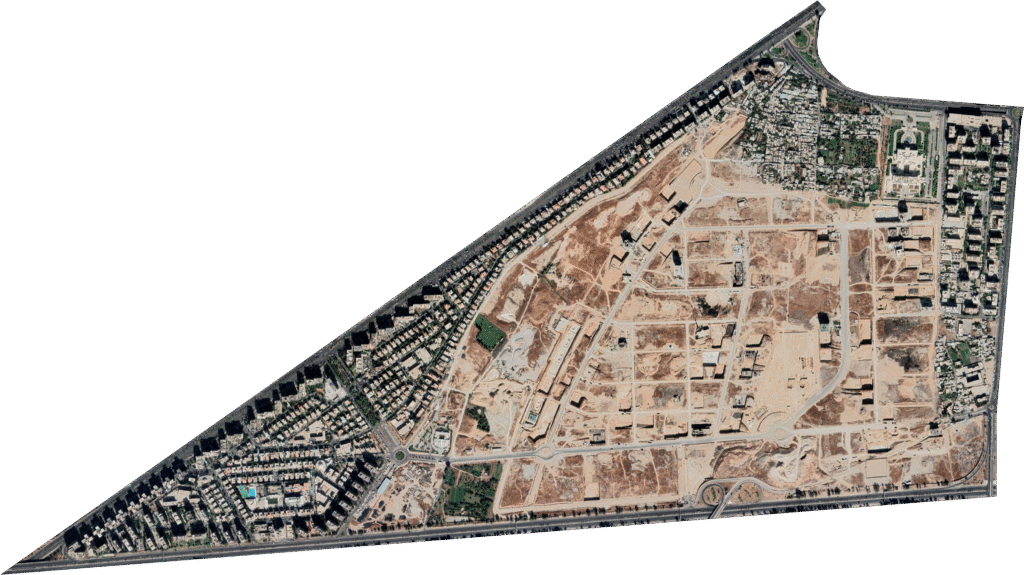
3D reconstruction model of Marota City showing the spatial configuration of new luxury towers and urban blocks planned under Decree 66, replacing the demolished Basateen al-Razi neighbourhood.
To answer this question, it’s relevant to turn towards some of the major reconstruction projects that began during Assad’s rule. Most famous is Marota City: a luxury development project in southwestern Damascus launched in 2012. Framed as ‘a new landmark of the city’ built with towers, luxurious residences, restaurants, hotels and financial institutions among other things1, it, in fact, slowly swallowed up the land, leading to the complete destruction of the area and dispossession of 50,000 local residents2 while enriching the cronies of the regime.3 The development project showcases how the Assad regime used planned reconstruction ‘to cement new demographic realities, terrains, and histories to secure a hegemonic position.’4 Our investigation uses Marota City as an entry point to question how reconstruction in this transitional phase is being used to materialise social, political and economic relations into the fabric of the nation.

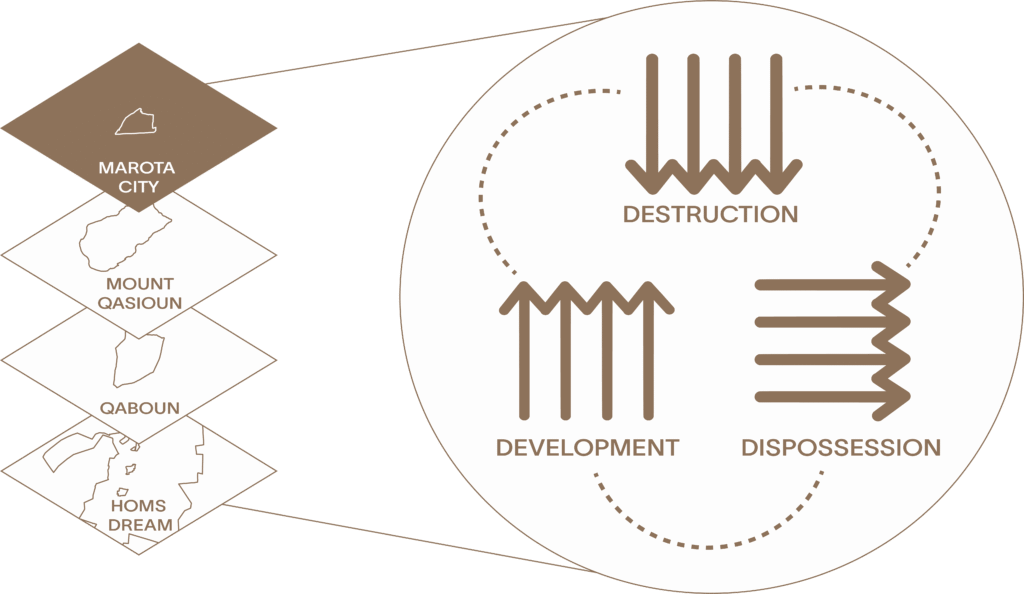
This investigation examines how political and business elites have used reconstruction to accumulate their political and economic power.5 Through our research on Marota City, we have located three key mechanisms used by the former regime to configure reconstruction: dispossession, destruction and development. These mechanisms are not operating through a chronological temporality, but, instead, work in conjunction and fuel one another at each reconstruction site. Destruction of neighbourhoods leads to dispossession and generates vacant space for development companies to move to the site. But the opposite is just as true: development dreams fuel destruction of the existing urban fabric, necessitating dispossession of residents from their homes. In times of conflict, the wish to dispossess certain strategic areas or demographies can motivate the use of destruction and development. The investigation, using Marota City as an entry point and as a mode of inquiry, asks if and how these logics continue to be reproduced in the current moment – what are the continuities and discontinuities in the present moment of reconstruction?
By investigating three ongoing development sites, we attempt to understand the architecture of unjust reconstruction, how it operated during the former Bashar Al Assad regime, and how to prevent its continuation in the present day. By architecture we mean both the physical structures that are built or destroyed, and architecture as a ‘conceptual’ mode of understanding – this process of reconstruction as a constructed reality by government officials, foreign investors and property developers.6
Our investigation centres around three mechanisms of reconstruction: dispossession, destruction and development. In order to fully understand each of these mechanisms, we have investigated three different sites while highlighting the working of one of them in relation to Marota City. By this, we have tried to gain a better understanding of how they operate.
In dispossession, we investigate real estate development on Mount Qasioun outside of Damascus. We try to understand what it means to be and feel in possession, and how it relates not just to private property but also to identify with shared spaces and landmarks, and being part of decision-making surrounding those.
In destruction, we investigate the area of Qaboun outside Damascus, a site that was destroyed during the Assad regime. We try to understand why entire neighbourhoods were excessively destroyed beyond war-related damage during the war and how it played a part in reimagining the city.
In development, we investigate the current project of Victory Boulevard in Homs, and its relation to the former regime’s project of Homs Dreams. We try to understand financial transactions and flows of power and how they are made visible and invisible through design and construction of new cities at large.
The operation of these mechanisms and how they intersect point to three key questions to ask of any reconstruction site: what is being developed and for whom? Who decides what gets destroyed in the process and why? How does it enable dispossession and what should you consider when undoing dispossession?


Marota City
Marota City, once was farmland of a working-class neighbourhood7, Basateen al-Razi, Mazzeh area. It became a primary node to investigate the unjust development, which had been prolonged through ‘conflict elite’–those who facilitated the former Assad regime’s control. Key figures included businessmen in the Assad regime: Samer Foz, Hussam Al Qaterji, and Mohammad Hamsho under the private sector holding company fully owned by the Damascus Governorate, Damascus Cham Holding Private JSC.

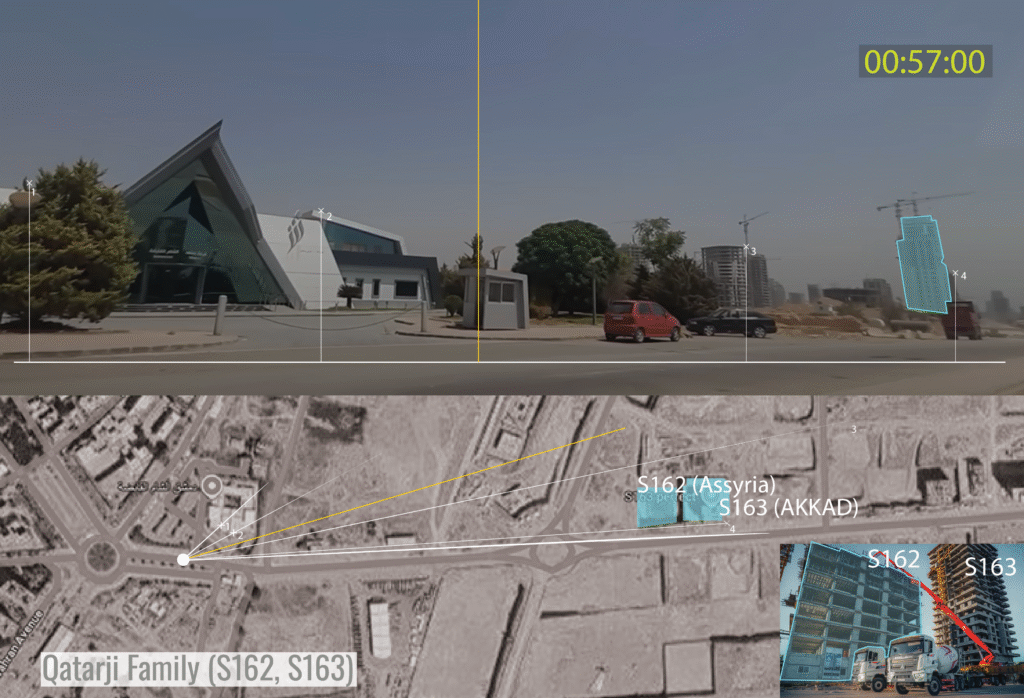
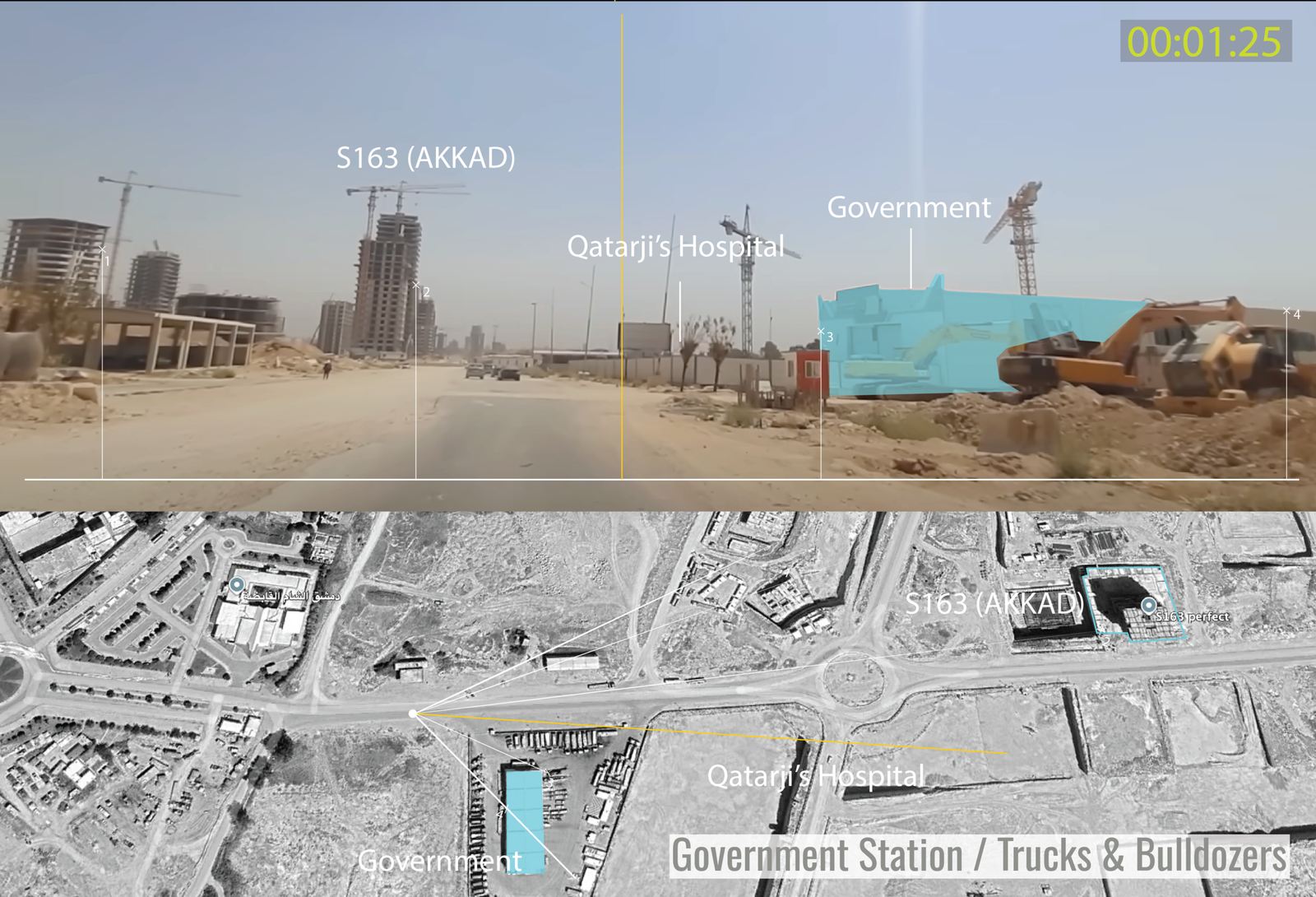
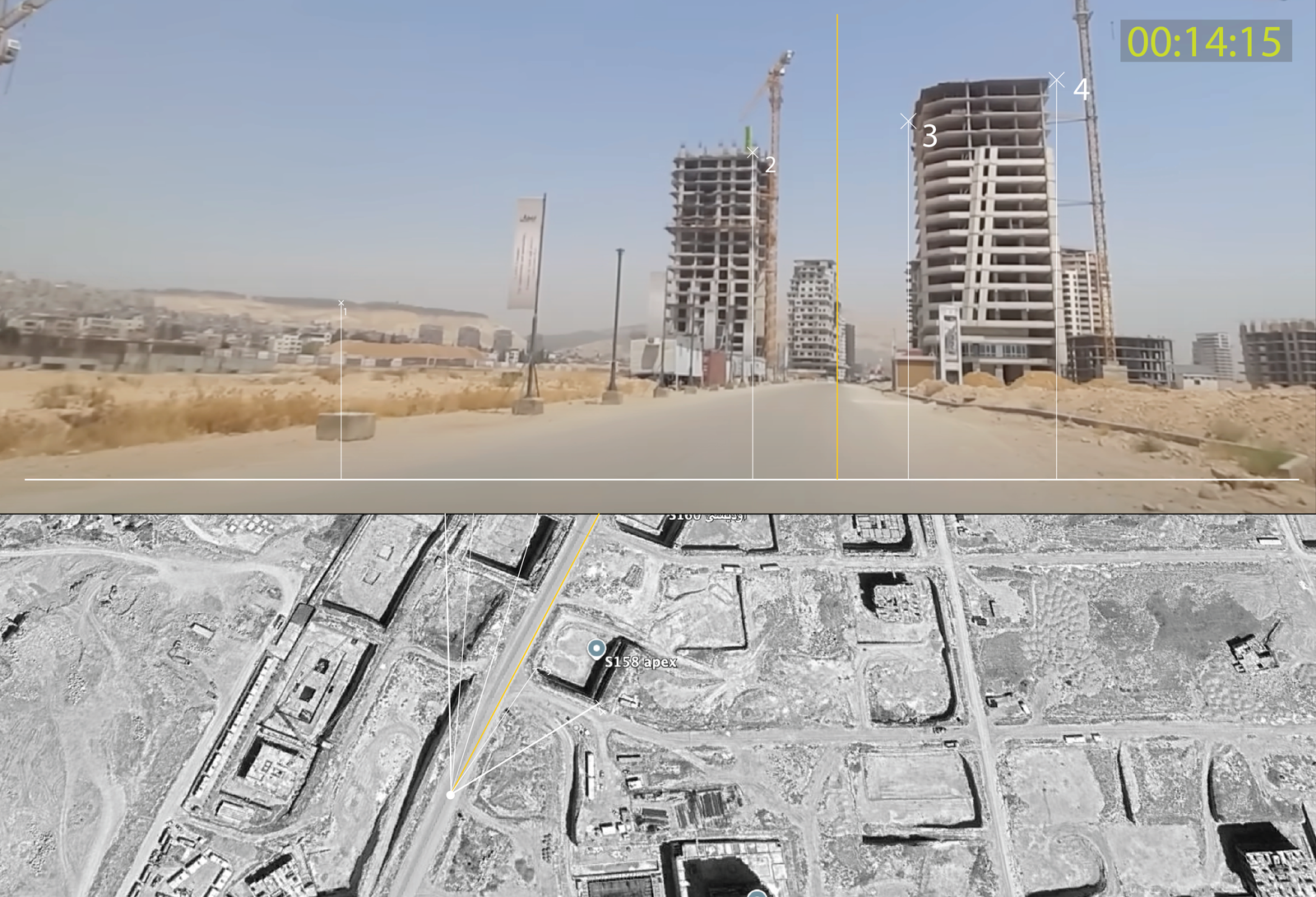
The video and image above show vehicle footage of ongoing construction activity in Marota City, Damascus (2025). The annotated image identifies key developments including S163 (Akkad), Qatarji’s Hospital, and adjacent government facilities with stationed trucks and bulldozers, indicating active state-linked construction and site clearance.
Timeline
Rumours circulate that Basateen al-Razi community will be displaced

Enactment of Decree No. 66
Demonstration in Al-Mustafa Mosque, Mezzeh (20 Jul 2012)

20-30% area razed to construct the first roads

Decree No. 19 of year 2015, allowed establishment of Syrian holding private closed joint stock companies authorised by the administrative unit and under its direct supervision to invest in and manage the urban planning and property development

Roads were expanded across the entire neighbourhood in 2016, based on our map analysis

Displacement and demolitions take place

Law No. 10, ratified April 2, 2018, and amended on November 11, 2018


The Syrian International Islamic Bank (SIIB)
The Syrian International Islamic Bank (SIIB) – where Samer Foz is a shareholder purchased a plot in Marota City worth SYP 320 billion, equivalent to USD$23.6 million at the official exchange rate of SYP 13,600 per dollar, according to a special disclosure submitted to the Syrian Commission of Financial Market and Security (SCFM).
A large central concrete construction company sits in the middle of Marota City
A. A. Syria Towers Private JSC, subsidiary of Qaterji company, is established
Arfada Petroleum Holding completes several construction projects
- August 12, 2024 – Arfada Petroleum Holding announced the completion of the construction works of its headquarters and several petrol stations in Marota City in Damascus, becoming the “first investment project” in Marota, according to the company. (August 12, 2024). Arfada confirmed that this project is linked to its subsidiary, Golden Gate for Transport and Oil Services LLC.
- A. A. Syria Towers Private JSC announced two construction projects, a 22-storey residential commercial tower and a 23-storey residential tower, in Marota City through its company, A. A. Syria Towers Private JSC. The headquarters of the Qatarji Group announced to be located in Marota City too.
Marota City Hospital renderings depict a large Qaterji Holding Group graphic, with construction progress seen in a 2019 video, built by Qaterji Engineering and Mechanical Industry
Marota City as a Mode of Inquiry
The timeline of Marota City demonstrates how the Assad regime used the three mechanisms of dispossession, destruction and development to establish its formation. By looking at three current sites of reconstruction, the investigation demonstrates how these three mechanisms are continuing to be used in this transitional phase. The three sites we investigate are Mount Qaisoun, Qaboun and Victory Boulevard. Each of these sites are used to analyse one of the three mechanisms. However, dispossession, destruction, and development do not happen in insolation – all three are taking place concurrently across the three sites but to demonstrate the operations of each mechanism, only one is picked as the focus for each site. By reading these three sites together, we begin to understand that ‘reconstruction’ isn’t a linear unfolding of progress, but rather, reconstruction efforts may be used to cement structures of political, economic and social power.
- According to the Marota City website. ↩︎
- Suhail Al Ghazi and Noor Hamadeh, “Violations in Government-Held Areas,” The Tahrir Institute for Middle East Policy, April 2, 2021. ↩︎
- Edwar Hanna and Nour Harastani, “Is Marota City the Type of Reconstruction Syrians Need?”, The Aleppo Project, May 14, 2019. ↩︎
- Nasser Rabbat and Deen Sharp, Reconstruction as Violence in Syria (AUC Press, 2025), 5. ↩︎
- Ammar Azzouz, Domicide (Bloomsbury Publishing, 2023), 17. ↩︎
- Eyal Weizman, Hollow Land: Israel’s Architecture of Occupation (London: Verso, 2007), 6. ↩︎
- Zeina Karam. “Syria plans to replace rubble with luxury developments.” The Christian Science Monitor, November 5, 2018. ↩︎