Operational Conditions
“We had reached al-Qatifa, a checkpoint we called the ‘crossing of death’ in Idlib because so many of our young men had disappeared there … We continued on our journey, passing through many other checkpoints, and every time we did so, I felt terrified all over again.”1
Checkpoints can serve a range of economic and military functions that vary by location. A range of publications have highlighted how checkpoints can be used to extort bribes civilians, identify and detain draft evaders and deserters, and restrict internal movement through cities and border crossings. To do this, these engineered bottlenecks (e.g. chokepoints) can contain the population within a territory and suppress dissent. One of the most common practices used to facilitate this process is identification checks. Different areas require different forms of identification; for example, the regime government in Idlib did not recognise identification issued by the interim government in the Aleppo countryside and vice versa. This has caused many civilians to juggle multiple documents at once2.
The treatment of civilians at a checkpoint is highly dependent on the specific function of that checkpoint and the individual attempting to cross it, however ID checks can be a tool militaries use to identify possible threats and a reason to demand bribes, “taxes,” or fees from traders and civilians. From our research, it seems that local businessmen negotiate exclusive deals with regime or militia actors to move supplies through these routes, creating monopolies on essential goods. Once inside, goods may be hoarded and sold at extreme markups, sometimes as high as 70 percent3.
With the regime unable to pay soldiers’ wages in full, due to increasing economic constraints, it has been cited that soldiers posted to checkpoints are encouraged to extract as much money as possible before they are moved to another posting, which may not prove as lucrative. The system is semi-regularised: the soldiers are allowed to keep a certain portion of the revenue they generate, with the rest going to the regime’s coffers4.
“During the spring of 2014, soldiers from the Presidential Guard and Air Force Intelligence took $2 for each kilogram of food allowed into eastern Ghouta at the Wafideen Checkpoint, which later became known as the ‘One Million Crossing’ as soldiers were believed to make SY £1 million per hour (roughly $5,000) from bribes.”
Unpredictable fear appears to be an important element in maintaining the extractive power of checkpoints, especially since the uprisings in 201156, for example by specifically targeting health workers7. One traveller describes the regularity with which checkpoint officers search her bag and scatter her belongings, forcing her to rearrange them. She claimed they did this deliberately, hoping for a bribe in exchange for not searching the bags8. Failure to comply with bag searches or ID checks can result in severe consequences, including forced disappearances. The Syrian Network for Human Rights identifies checkpoints as one of the leading locations for the more than 85,000 forced disappearances that occurred between 2011 and 20179.
Finally, checkpoints can also control the flow of humanitarian aid across the country. This has further downstream effects on the local Syrian economy. The United States Government Accountability Office reports that “partners we interviewed that relied on transporters to deliver assistance within Syria mitigated the risk of loss—including loss due to theft by the Syrian Army or armed opposition groups at checkpoints—by shifting liability to the transporter and only paying for parcels that were delivered to the intended destinations“10.
Reuters11 reports that 70% of the aid directed to Eastern Ghouta during the siege was “eliminated” by regime checkpoints. Further incidents are reported12 in different parts of Syria, causing speculation that the UN aid is being systematically sold on private markets.
A resident in Homs said that diapers were always removed from aid shipments under the pretext that they could be used as bandages for injured fighters.13
As we will see, it seems to be a common strategy to place checkpoints on vital transportation arteries to control movement. Placing checkpoints in narrow geographic areas, like bridges, or intersections, maximises their control and reduces the manpower required to defend them14.
The following case studies illustrate the ways checkpoints operate in series and networks, fulfilling complementary functions to form comprehensive border strategies to direct and regulate the movements of goods and people.
Case study 1: Sugar factory – Economic Control
As regime forces were deployed to suppress the 2011 anti-government uprisings in Homs15, they established checkpoints in both the north and south entrances to Homs via the M5 (Damascus Aleppo International Highway) to inspect vehicles entering and exiting the city.
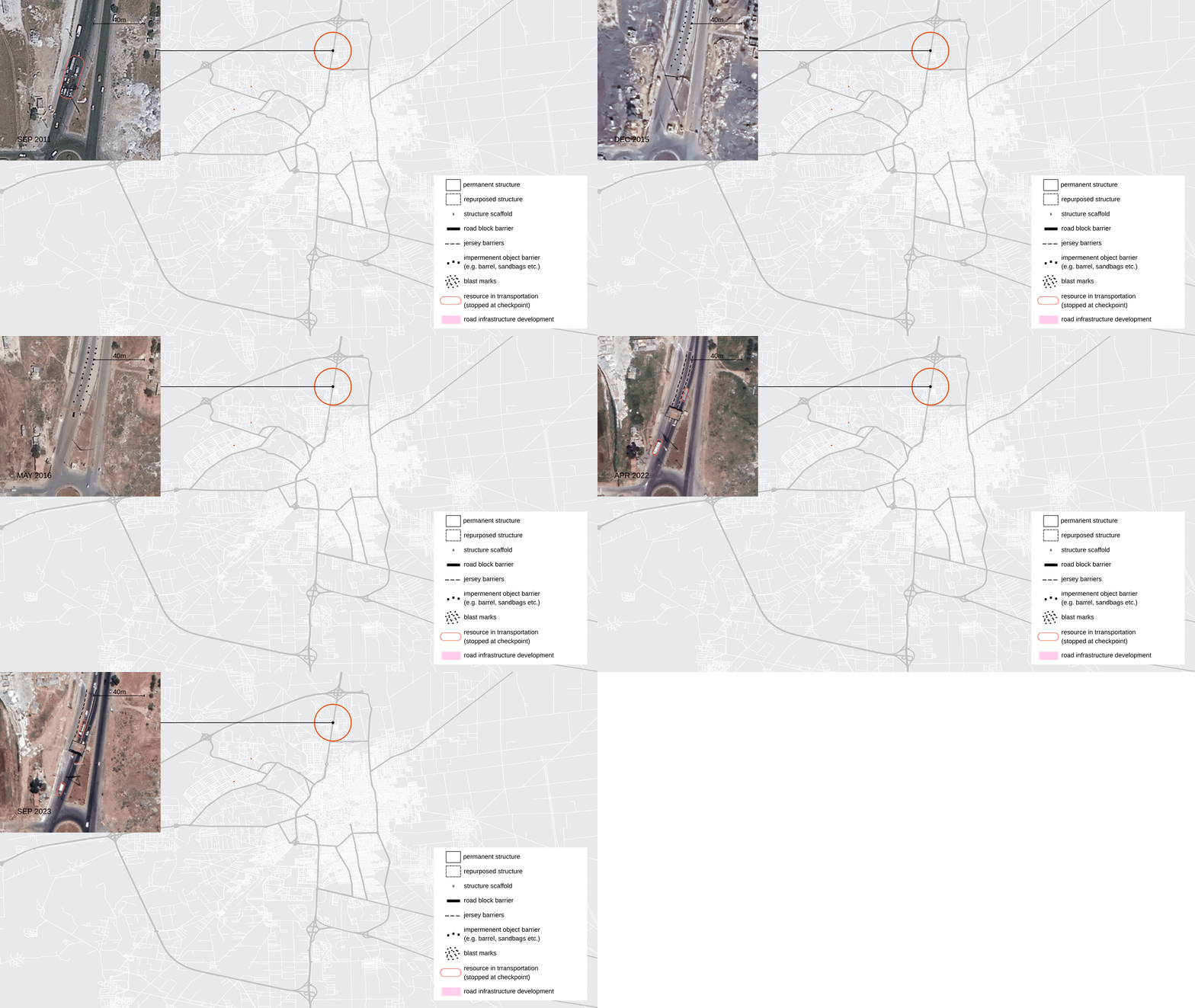
In the north, regime forces established a checkpoint near the Homs Sugar Company16 ( المكتب الاعلامي) and by a large parking garage17 in the industrial neighbourhood of Al- Hasaweyyah (الحاصوية); these two landmarks are used to distinguish the checkpoints, which are colloquially referenced as “Sugar Factory” or “Pullman Garage” Checkpoint, reported used, for example for “customs checks” on mobile phones18. We mentioned the Sugar Factory in our introduction on Syria’s specific geographical, social and economic context as one of the most strategic employers in Homs, and also impacted by the resources chokepoints to the north19.
Aside from being on a major road running through Homs, the location of the Sugar Factory checkpoint is also critical as it is located in a major industrial area in northern Homs and its surrounding outskirts. This area roughly spans the neighbourhoods of Al- Hasaweyyah (الحاصوية), Al- Hilaliyah (الهلالية), Deir Baalbeh (دير بعلبة), and Al-Badaya (والبياضة). . Local social media posts from as early as 201320 indicate that the Sugar Factory checkpoint was controlled by Air Force Intelligence, which reportedly21 oversaw22 the checkpoints at the other main entrances to the industrial area. Based on these pictures, we were able to geolocate the ‘span of control’ potentially up to Talbisa (تلبيسة) where reports indicate the Fourth Division operated checkpoints which profited from smuggling fuel23.
While there were allegations24 of extortion and random arrests of individuals passing through, the Air Force Intelligence’s control over the northern industrial area granted them the opportunity to extract wealth from the factories and extended even further25. In 2023, the Syrian Observatory26 published a report that claimed Air Force Intelligence leadership imposed fees on factories and threatened forced closure upon establishments that didn’t pay.
Case study 2: Al-Wa’er – a cluster of checkpoints
Checkpoints do not necessarily occupy a single geographic point. As a chokepoint, they may form a cluster or group, potentially run by different or even rivalling groups. An example of such a chokepoint is a cluster of 4 individual checkpoints in north Homs, in the Wa’er area on the way into the city from Masyaf. They are of particular relevance due to their strategic position during the siege of Homs27 between 2011 and 2017.
Two checkpoints around the Military College and the Automated Bakery, sometimes called the “Al Ghaba” or Forest checkpoint, appear in satellite imagery in 2011, which we corroborated using data from a community mapping platform made by a Homs activist and an account from a witness we spoke to from the area. The two checkpoints allegedly had different purposes: one focused on ID checks and detection and the other on search and confiscation of goods. According to HRW reports28 , they also had a military purpose. For example, as mentioned in our case study 4, it was the Wa’er only exit point29 during the siege of the area. The checkpoints were reportedly used for kidnappings30 and for negotiations with Russian allies in 2016. In 2018, the pair were fortified and expanded, with a third appearing along the same stretch of road. According to unverified witness testimony, the one at the ring road was run by Air Force Intelligence, whereas the older ones were run by state security and military.
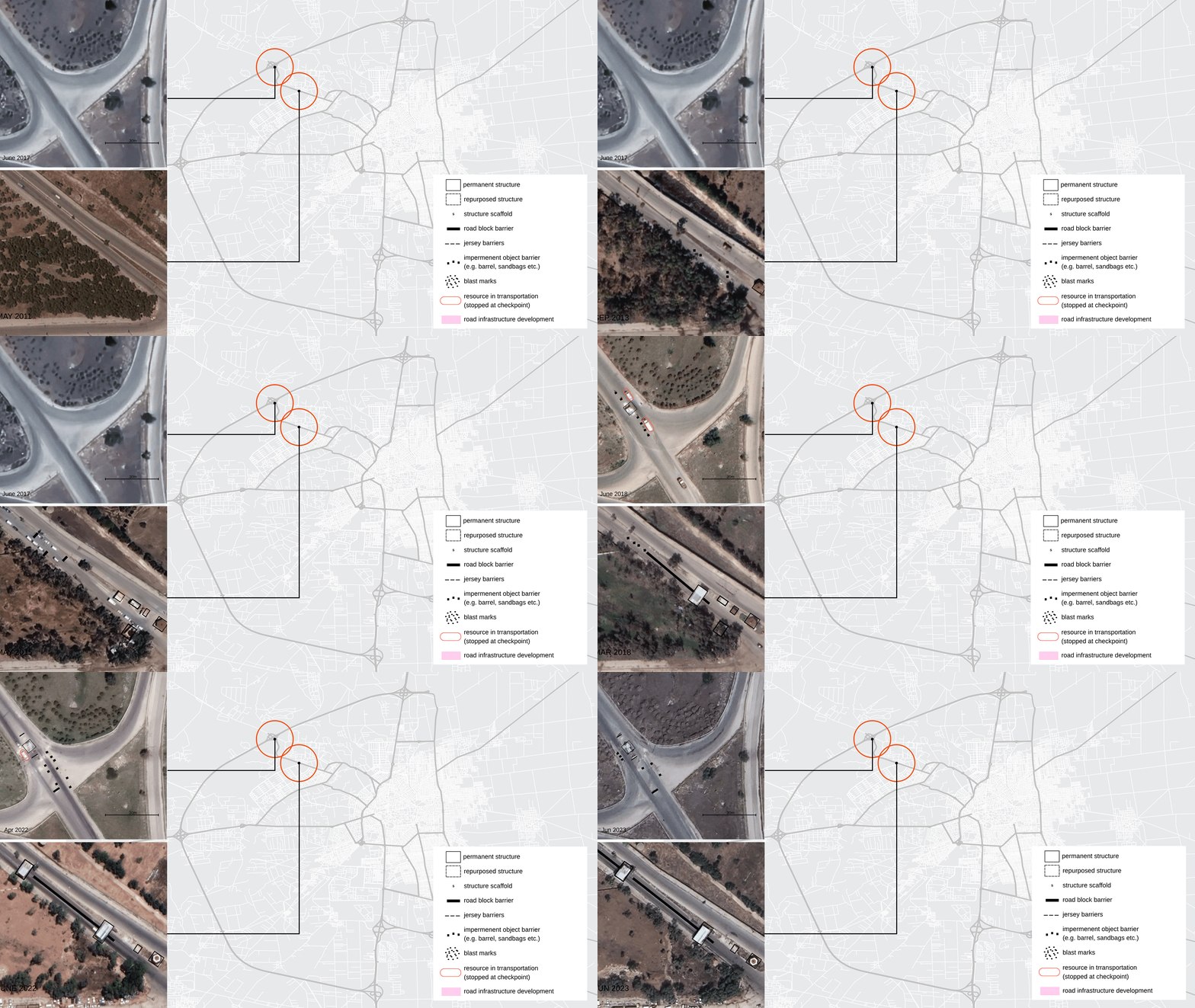
Finally, in 2022, another checkpoint appears in front of the fortified one. We were not able to identify its purpose. We also could not find evidence that the checkpoints were specifically operated by the Fourth Division, although some checkpoints in western Homs were31. Of all neighbourhoods affected by the siege of Homs32, which ended in 2017, Wa’er was under threat for the longest. These fortifications lasted after the siege ended in 2017.
Case study 3: Lebanon border crossing – sign of strength
Checkpoints may be organised like a net or web around a large geographic area of interest. They may be operated by different groups like intelligence services or separate military divisions. They operate on a higher level of flow as a chokepoint, not only being able to restrain a core traffic axis or entire area but, beyond that, perform to rivalring groups, even other countries, combat-readiness and vigilance.
One such example is the Masnaa / Jdeidet Yabous border checkpoint between Syria and Lebanon, which lies along the M1 to Damascus. The Syrian / Lebanese border has historically been even more porous33 than Syria’s already fragile borders, as we mentioned in our introduction. Reports34 highlight the different fractions involved: “The checkpoints … are spread in several directions“. Multiple groups constantly struggle for control.
The border crossing has existed since ancient times but the first recent tightening was in 2011, when during the Arab Spring protests traffic declined by 50% and “All [trucks] are subject to thorough inspection by customs and security forces at Jdeidet Yabous“35. Using satellite imagery, we can show the development, extension and fortification of 3 out of the many checkpoints on the Masnaa axis around 2013 when Hezbollah intervened36 around the town of Qusayr, destabilising the entire Lebanon-Syria border37 tragically displacing many civilians for years38. Yet, Fortifications continued despite the Qalamoun offensive ending in 2015 and displaced people returning in 2018.
Official statements acknowledge 27 unofficial crossing points along the disputed border39, yet some sources mention up to 124 and mention frequent incidents of smuggling40 by Syrian regime forces. The checkpoint net exert power over a large area, often with additional military outposts, aimed at controlling the flows towards the border itself, but also the hinterlands, controlling smuggling and supply routes, imposing high taxes on everyone as some reports indicate41. A 3D terrain map illustrates how the straight M2 route leads through a valley that, by itself, would not require such heavy and dense security along the way. However, we posit it’s the porosity of the flows around it leading to its fortification:
We identified at least 8 checkpoints, 4 selected ones shown below in a timeline 2011-2024. Top left we show the crossing itself as a reference, which allows us to clearly tell how, for example one checkpoint around Al-Zabadani experienced its growth post 2020, bottom right:
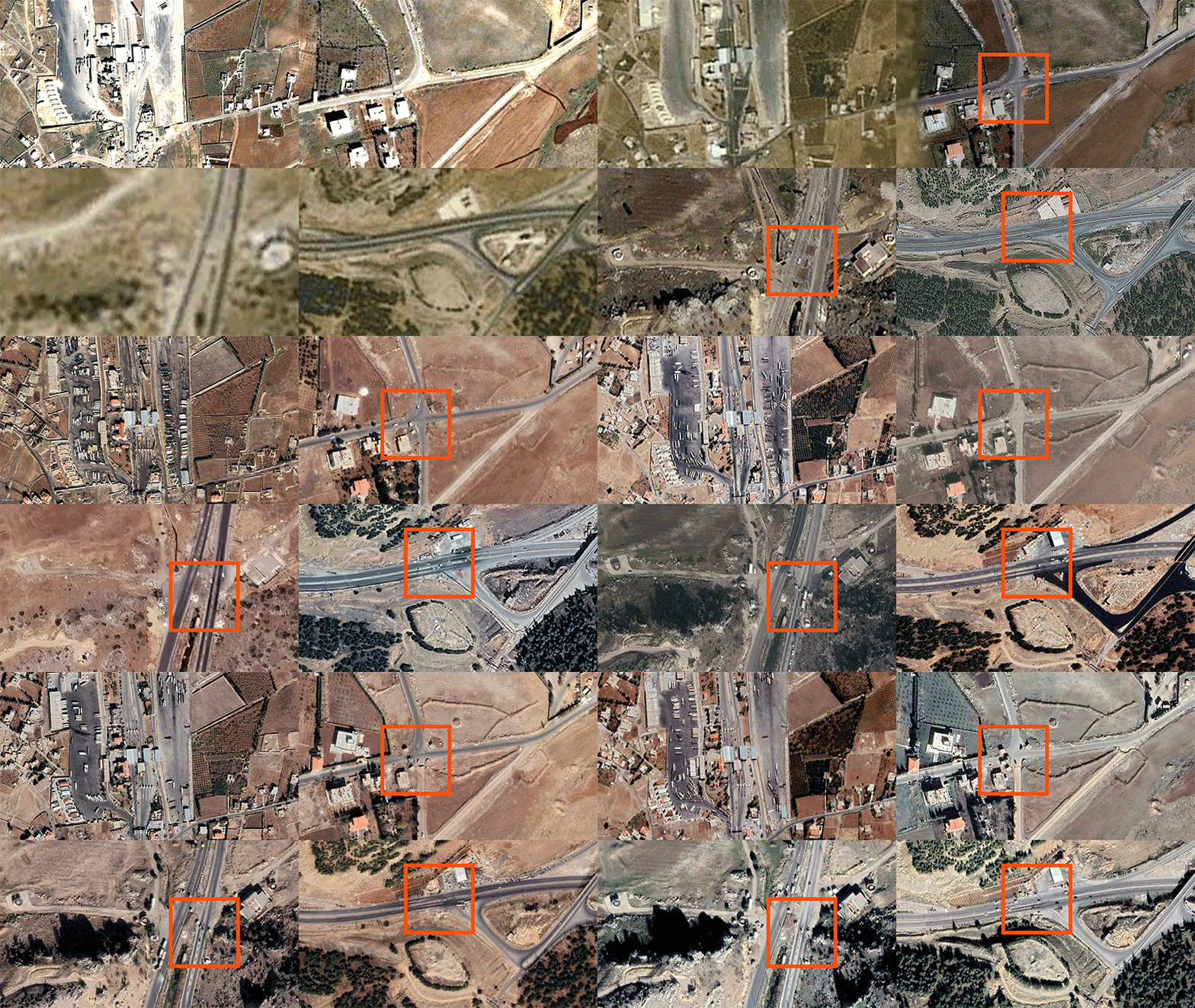
Most crossing points would likely be under control of the Fourth Division. We can conclude this given Maher al-Assad’s villa was located42 in Yaafour along the M5, just before entering the valley, in 2023 reports surfaced on Forth Division checkpoints causing political turmoil within the regime and its allies due to the smuggling business with Hezbollah43, and reports from 2023 mention fuel seizures and smuggling “for more than two years“44 until at least February 202445, matching reports46 that enforcement on smaller mountain roads intensified from 2021 onwards. Very recent research reported on the metal scrap business there47, on top of the Forth Division’s copper business48. Since the fall of the regime at the end of 2024, which aligned itself with Hezbollah especially in this area49, Syria’s new administration vowed to turn these nodes of extraction back into actual anti-smuggling operations50.
The closest checkpoint on this map marked “Metal Scrap Checkpoint” is based on a recent investigation by The New Arab51 in collaboration with SIRAJ52 and El Pais. In our context introduction we highlighted the Forth Division’s economic control, and this new research zooms in the scrap metal trade. The team investigated first hand a scrap metal hub around Yafour Bridge, identifying at least “In just one month, the 4th Division was planning to extract … from 100 scrap metal trucks en route to Lebanon“. Once again, this highlights the economic motivations alongside the military strategy behind this web of extraction. Military prowess and alliances53 were used to establish nodes of control which were then moved towards economic purposes once the regime needed intermediaries and allies due to the sanctions imposed to survive.
- al-Hassan, Manal, “The Power of a Costly Document in Syria,” Institute for War and Peace Reporting, July 29, 2015. ↩︎
- Hamza Hamza, Mahmoud, “Idlibs’s de facto authorities issue new ID cards: A ‘temporary solution’ or more chaos?,” Syria Direct, September 20, 2022. ↩︎
- Todman, Sieges in Syria: Profiteering from Misery. ↩︎
- ibid ↩︎
- Human Rights Watch, “We Live as in War: Crackdown on Protesters in the Governorate of Homs, Syria,” Human Rights Watch, November 11, 2011. ↩︎
- Human Rights Watch, “أقبية التعذيبالاعتقال التعسفي والتعذيب والاختفاء القسري في مراآز الاعتقال السورية,” Human Rights Watch, 2011. ↩︎
- Rayan Koteiche et al. “‘My Only Crime Was That I Was a Doctor’: How the Syrian Government Targets Health Workers for Arrest, Detention, and Torture.” Physicians for Human Rights, 2019. ↩︎
- Syria TV. “بعثرة الحقائب وسرقة بحجة تصريف الدولار.. حواجز النظام على طريق دمشق – بيروت.” Syria TV, August 6, 2022. ↩︎
- Human Rights Watch. “Torture Archipelago: Arbitrary Arrests, Torture and Enforced Disappearances in Syria’s Underground Prisons since March 2011.” Human Rights Watch, July 3, 2012. ↩︎
- United States Government Accountability Office. Syria Humanitarian Assistance: Some Risks of Providing Aid inside Syria Assessed, but U.S. Agencies Could Improve Fraud Oversight. United States Government Accountability Office, 2016, p.23. ↩︎
- Azhari, Timour. “Quake Response in Syria Faces Obstacles, Says Top U.N. Aid Official.” Reuters, February 6, 2023. ↩︎
- Enab Baladi. “Damascus Checkpoints Are Being Removed… Has Syria Become ‘Safe’?” Enab Baladi, June 27, 2018. ↩︎
- Todman, Sieges in Syria: Profiteering from Misery. ↩︎
- Schon, “The Centrality of Checkpoints for Civilians During Conflict.” ↩︎
- Thompson, Nick. “Homs: Bloody winter in Syria’s revolution capital.” CNN, February 7, 2012. ↩︎
- Homs Sugar Factory.
تنسيقية حي الإنشاءات [inshaat.homs1] on Facebook May 25, 2014. ↩︎ - Syria Community Walk on Wayback Machine ↩︎
- Halab Today TV. “خاص | حملة اعتقالات في حمص بسبب “الجوالات”.. ما علاقة أسماء اﻷسد؟.” Halab Today TV, January 2, 2024. ↩︎
- Syria TV. “توقف معامل السكر والخميرة والكحول والزيت والصابون في حمص.” Syria TV, August 12, 2023. ↩︎
- Inshaat.homs1, 28 November, 2013. ↩︎
- Syrian Observatory for Human Rights. “بذرائع منها عدم وجود الرخص.. رئيس فرع المخابرات الجوية بحمص يفرض إتاوات على المواطنين تعود عليه بملايين الليرا”ت السورية شهرياً.” Syrian Observatory for Human Rights, June 17, 2023. ↩︎
- Political Keys. “خاص | ضغط روسي ينهي تكليف اللواء “شفيق صارم” من إدارة المخابرات الجوية… و”بوليتكال كيز” تكشف الأسباب.“ Political Keys, January 30, 2024. ↩︎
- Enab Baladi. “الرئيسية > ناس > مجتمع لنشرهم على حواجز الحدود اللبنانية “الرابعة” تعزز اقتصاد التهريب بمنتسبين هاربين من “الإلزامية” Enab Baladi, January 8, 2023. ↩︎
- Syrian Observatory for Human Rights. “‘As if it is border checkpoint between two countries’. Airforce Intelligence imposes tightened security at northern entrance to Homs coinciding with Al-Assad visit.” Syrian Observatory for Human Rights, September 11, 2022. ↩︎
- Nedaa Post, “نهاية مأساوية لشابين في حمص رفضا منح ضابط في النظام السوري شقة سكنية.” ↩︎
- Syrian Network for Human Rights, “بذَرائعٍ منها عدم وجود الرّخَص… رئيس فرع الأمن السياسي في الرقة يصادر مُعداتِ محالٍّ تجارية ويبتَزُّ أصحابها.” ↩︎
- Wikipedia, “Siege of Homs.” ↩︎
- Human Rights Watch. “سوريا- تصاعد الإعتداء على منطقة تسيطر عليها المعارضة,” Human Rights Watch, March 4, 2015. ↩︎
- Wael Abdel Hamid. “الوعر: الثورة، الحصار، التهجير.” Al-Jumhuriya, August 10, 2017. ↩︎
- Al-Araby, “حيّ الوعر الحمصي… من الحصار والتهجير إلى ‘التسوية’.” ↩︎
- Syrian Observatory for Human Rights. “الفرقة الرابعة تحول ريف حمص الجنوبي الغربي لمنطقة أمنية تابعة لحزب الله اللبناني.” Syrian Observatory for Human Rights, April 29, 2023. ↩︎
- Wikipedia, “Siege of Homs” ↩︎
- Asharq Al-Awsat, “هشاشة الحدود السورية ترسم علاقات شائكة مع دول الجوار.” ↩︎
- Alaraby, “الحواجز الأمنية في سورية: مراكز ابتزاز تزيد معاناة المدنيين.” ↩︎
- Al-Akhbar, “The Lebanese-Syrian border is paralyzed,” April 18, 2011, p. 17. ↩︎
- Al Jazeera, “الحر يحذر من تفجّر الوضع بحدود لبنان.” Al Jazeera, March 4, 2013. ↩︎
- Al Jazeera, “خطورة استباحة سوريا لسيادة لبنان,” حديث الثورة.” Al Jazeera, June 11, 2013. ↩︎
- Pro-Justice, “العربية 8 سنوات من سيطرتها عليهـا القصي…” Pro-Justice, April 17, 2024. ↩︎
- Al-Araby Al-Jadeed. “هل تعلم أنّ هناك 27 نقطة حدودية خلافية بين لبنان وسورية؟.” Al-Araby, March 20, 2025. ↩︎
- Shaam News Network. “فيديو يوضح اشتراك عشرات من أنصار النظام في التهريب إلى لبنان.” Shaam News Network, February 25, 2024. ↩︎
- Syrian Network for Human Rights. “الفرقة الرابعة تستلم بعض من حواجز “الدفاع الوطني” في القلمون الغربي على الحدود مع لبنان وتضيق الخناق على الأهالي من خلال فرض الإتاوات.” Syrian Network for Human Rights, September 12, 2021. ↩︎
- SNHR, 2024 ↩︎
- Political Keys, 2023 ↩︎
- Syria TV, Voice of the capital, 2023 ↩︎
- Suwayda24 on x.com, 2023 ↩︎
- Syria TV, Voice from the Capital, 2023 ↩︎
- Cherici et al., The New Arab, 2025 ↩︎
- AFP, 2025 ↩︎
- Wikipedia, “Hezbollah involvement in the Syrian civil war” ↩︎
- Al Arabiya, 2025 ↩︎
- Cherici et al., The New Arab, 2025 ↩︎
- Bassiki et al., Siraj, 2025 ↩︎
- Reuters, 2013 ↩︎