
Metal
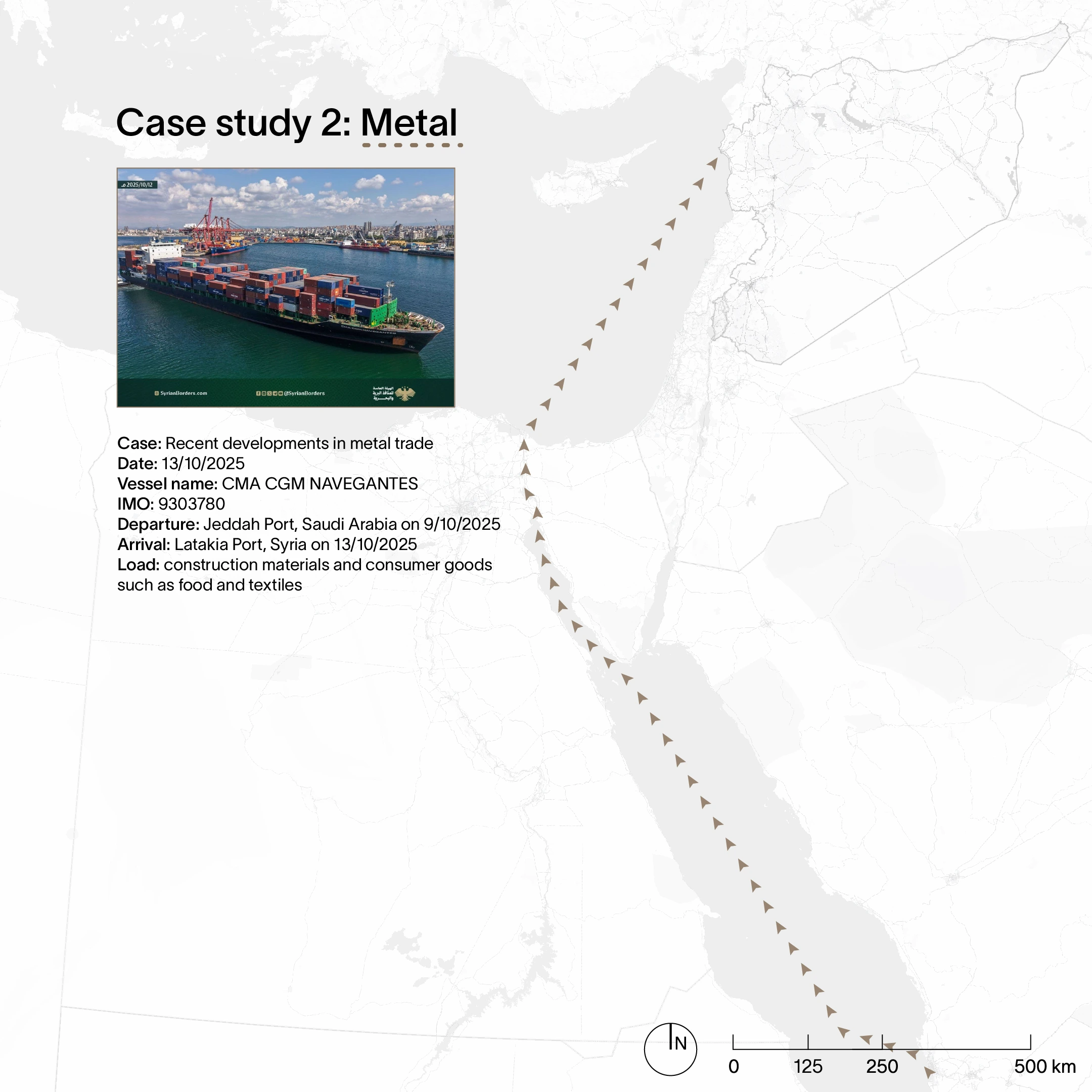
On October 13, 2025, the NAVEGANTES, a container vessel operated by CMA-CGM arrived at Latakia Port2—one of the largest-ever ships to dock in the harbour. According to Syria’s General Authority for Land and Sea Border Crossings, the ship’s cargo included construction materials and consumer goods, such as vehicles, food, and textiles for the Syrian market. This event, explained the Authority, signaled improved logistical and security conditions of Latakia Port, and provided an important step in restoring global confidence in the port as a key logistic hub in maritime trade3. For its return trip, the ship will be loaded with local products to be exported from Syria.
Of particular significance among the ship’s outgoing cargo was the inclusion of metal goods.
Amidst a transitional era in Syria where reconstruction needs are paramount, the metal trade continues to act as a sensor to ascertain:
- The new Syrian government’s priorities regarding the import, export, and internal national trade of metal as a commodity and industry.
- The material conditions of the Syrian people as indicated by their access to and interactions with metal.
- The entities and physical spaces which facilitate the Syrian metal trade today. Do Assad-era metal industry monopoly tactics, logistical networks, and key players persist in the present day?
Historical Context of Steel Trade
The Syrian Metal Company issues a ban against traders and shippers, regarding the buying and transporting of scrap metal.
The decision was made to avoid “the meddling of troublemakers” with infrastructure and safeguard the country’s resources.4
Al-Raml camp (south of Latakia port): Unexploded ordnance detonates during scrap metal processing, causing casualties and the destruction of residentail buildings.
After the fall of the regime, there was a rise in extracting metals from remnants of war for the purposes of selling them.5
The Syrian Ministry of Economy and Industry issued a decision to prohibit "the export of metal scrap and alloys of all kinds," taking effect at the end of June.
While they did not clarify the reasons for their decision, the scrap metal trade had been spreading in Syria in areas devastated by the conflict.6
The Latakia City Council cracks down on illegal scrap metal sites and junkyards within the district's boundaries.
The official Latakia Government Facebook page said the council will continue to remove all violations within the city.7
Latakia Port: NAVEGANTES (CMA-CGM) ship is loaded with manufactured metal goods from Syria for export.
Syria’s General Authority for Land and Sea Border Crossings called this event an important step in restoring confidence in the port as an important hub in maritime trade.8
The Fourth Division, an elite military unit in the Syrian Army during the Bashar al-Assad regime, “monopolised the trade of scrap metal, iron, and copper across Syria, including Aleppo, through a network of local intermediaries and warlord businessmen,” according to Ayman Al Dassouki, a researcher at the Turkey-based Omran Centre for Strategic Studies think tank in an interview with The National9.
A “small mafia” of 20 or 30 collectors10 collected metal from abandoned or occupied buildings within besieged areas and compel melting shop owners to buy it regardless of quality. The Fourth Division’s soldiers also conducted searches in the factories to ensure complete monopoly. Anyone who defied the division were shut out of scrap metal market through “denied permits for scrap extraction, transportation, and sales.”11
The Fourth Division had several business partners who helped them maintain this monopoly, the most prominent being Muhammad Hamsho, brother of former President Bashar al-Assad and leader of the Fourth Division, who had close ties to Maher al-Assad. After being placed under Western sanctions in 201112, he turned his attention to the Division’s war economy activities, including the scrap trade.
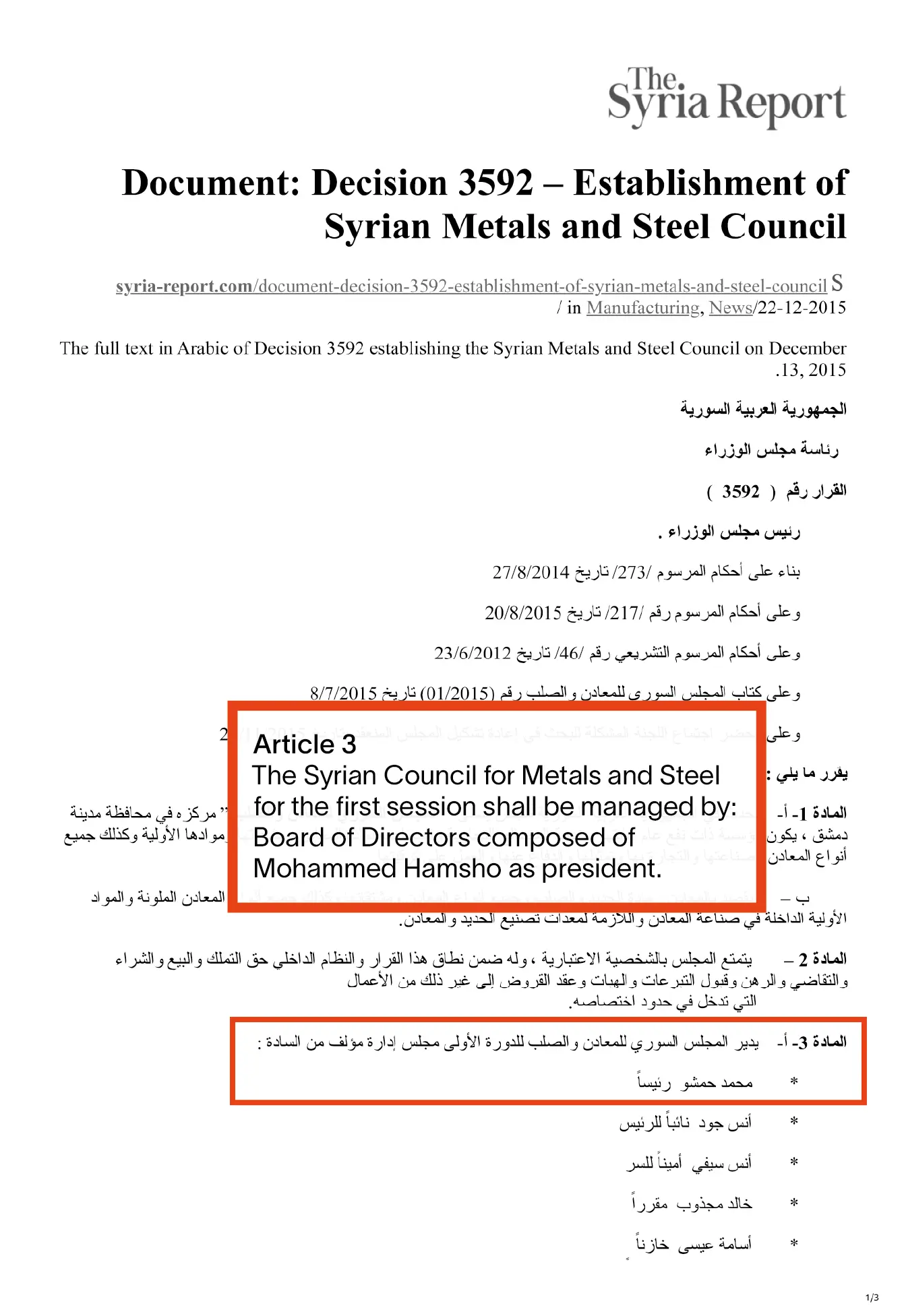
Hamsho was CEO of Hamsho International Group, believed to be a front for Maher Al-Assad, operating in sectors spanning engineering, construction, tourism, and communication14. He was also the President of the Syrian Metal and Steel Council15, whose roles included setting industry regulations, establishing production and pricing rules, and issuing certificates of origin. His siblings also established companies in electronics, telecommunications, and health sectors. These companies were awarded dozens of contracts by UN agencies despite sanctions against Hamsho16.
One of Hamsho’s metal processing plants was the Hadeed Metal Manufacturing Company, which reportedly processed all the scrap metal seized from destroyed infrastructure during military operations in Damascus17. Hamsho’s company helped demolish Qaboun, a suburb of Damascus, and extract the iron for his steel factories. In the neighbourhood of Basateen al-Razi, the first tower blocks for the government’s reconstruction project Marota City are being constructed using steel from the same factory18.
The Fourth Division’s forced locals to sell scrap metal collected during military operations exclusively to Hamsho International Group’s Hadeed Metal Manufacturing Company at low prices19. It is estimated Hamsho profited about $10 million from the steel trade in early 2019. In 2017, copper was among the highest raw material exports from Syria; the rest was used in the local market through government contracts favorable to Hamsho20.
With the fall of the Assad regime, the market for recycled metal stagnated with authorities prohibiting used iron in construction due to building safety. Despite the risks, Syrian people continued to turn to the country’s scrap metal trade to make a living21 and rebuild destroyed homes. For some that means extracting iron from the ruins of demolished and destroyed homes on the behalf of property owners who sell the scrap to workshops where it is cut and resold as recycled material. Others make a living buying iron by the kilo from property owners and venders and sorting what is ready to sell and what can be sold to a workshop. The lower price of recycled rebar drives demand amongst Syrians who are rebuilding their homes, as a ton of recycled rebar can reportedly cost between $200-300 compared to new rebar that costs up to $710.
Present Day
The interim government of Damascus issued a decision on May 13, 202522 prohibiting the export of metal scrap including iron, copper, aluminum and lead with implementation starting from the end of June. In the meantime, to meet the national demand of metal, especially for reconstruction purposes, the Syrian government has entered into trade deals to import metal, such as with Turkey and China.
Syrian people have continued to salvage scrap metal from destroyed buildings and homes, often with the original homeowners’ commission or partnership.
This collected metal has also included unexploded ordnance (UXO), remnants of the heavy bombardment of Syria. The processing of unexploded ordnance among scrap metal has led to numerous devastating incidents caused by detonated war remnants. One such incident occurred in the port-city of Latakia in the Spring of 2025, in the coastal neighborhood of Al-Raml Al-Janoubi, just south of the Port of Latakia.
Case Study
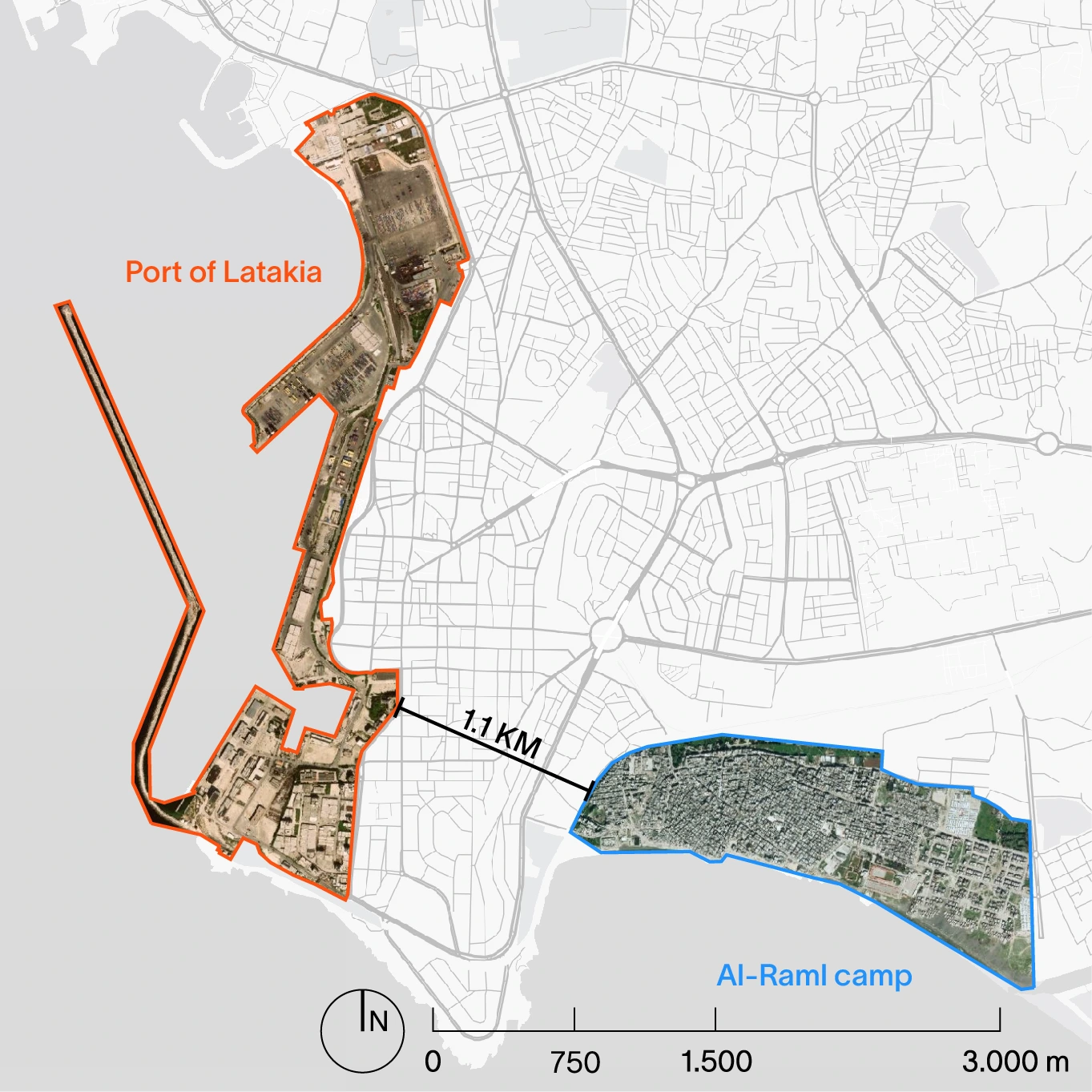
Al-Raml Al-Janoubi is a Palestinian refugee camp – home to the largest population of Palestinians on the Syrian coast – within Latakia city, just 1 kilometer away from Latakia port. In Spring of this year, a hardware store blew up after handling unexploded ordnance while processing scrap metal, destroying surrounding residential buildings. 16 people were martyred and 18 injured. It took the Syrian Civil defense 14 hours to complete their rescue operation.
We felt compelled to keep looking into this incident because of the tragic nature of how it unfolded, the dissonance of knowing Latakia Port is the site of large-scale logistical and capital flows of metals, and how peculiar it was that unexploded ordnance made its way to Latakia when the city did not experience the heavy bombardment that areas like Idlib or Homs experienced during the conflict.
Historical Context of Al-Raml Al-Janoubi
Al-Raml Al-Janoubi (which means Southern Sands) was established on the coast just south of Latakia port in 195224 by Palestinian refugees forcibly displaced by the Nakba in 1948. The population grew after Palestinian refugees fled to Al-Raml during the 1967 Naksa, and from other cities in Syria.
Conditions in Al-Raml Al-Janoubi
Because the camp is not officially recognized by UNRWA, residents rely on the local government to collaborate with the General Authority for Palestinian Arab Refugees in Syria for essential services and infrastructure such as water, sewage, electricity. UNRWA provides education and healthcare services to residents, but ultimately the material conditions in Al-Raml are tough, especially with Syria’s ongoing budget crises25. Due to difficulty getting permits and high population density, and high housing demand due to displacement and population growth, many of the residential structures are considered unpermitted or informal26.
Historically, Palestinian refugees in Syria have faced extremely high poverty levels, and it’s estimated that 90% of all Syrians live below the poverty level due to decades of war and dispossession27. In Al-Raml , many residents have made a living in informal work, the service industry, fishing or working for the Latakia Port28. However, this year there were mass layoffs of public employees under the new government affecting port workers, including those employed at Latakia port29.
Spatial analysis of Al-Raml Al-Janoubi
Suspecting that there was more information to ascertain about the metal trade in Latakia through spatial analysis, we sought to locate the site of the explosion to identify visual indicators of the scrap metal trade in Al-Raml and make larger connections between that processing site and other trade nodes and networks in the Latakia port-city.
We began by reviewing footage of the explosion for useful clues that would help us find the site of the explosion. We found three particularly useful images and videos shared on social media from AFP, the Syrian Civil Defense, and Arab News.
We narrowed down unique spatial markers in aerial footage, such as the unique shapes of buildings, roads, and vegetation. The panning video featured on Arab News helped us identify an overpass, and most significantly, railroad tracks where onlookers stood during the rescue attempt. These features made it possible for us to geolocate the site of the explosion, which happened to be on the very edge of the camp closest to the port and city center.
Through available visual representations of the explosion site in context to the larger port-city of Latakia, certain points of focus became immediately apparent:
- The appearance and size of the likely scrap processing site: Directly across from the site of the explosion, satellite images indicate the possible presence of a small-sized scrapyard. Visual changes to the site over the span of 2014 until 2023 show its continuous use as a host to assemblages of materials and trucks which drive in and park in the center of piles of material. The appearance of inconsistent piles of material implies the site’s use for initial sorting and processing of metal scrap before re-melting, as there were no visible indicators of furnaces or further processing equipment in the satellite images or videos shared online.
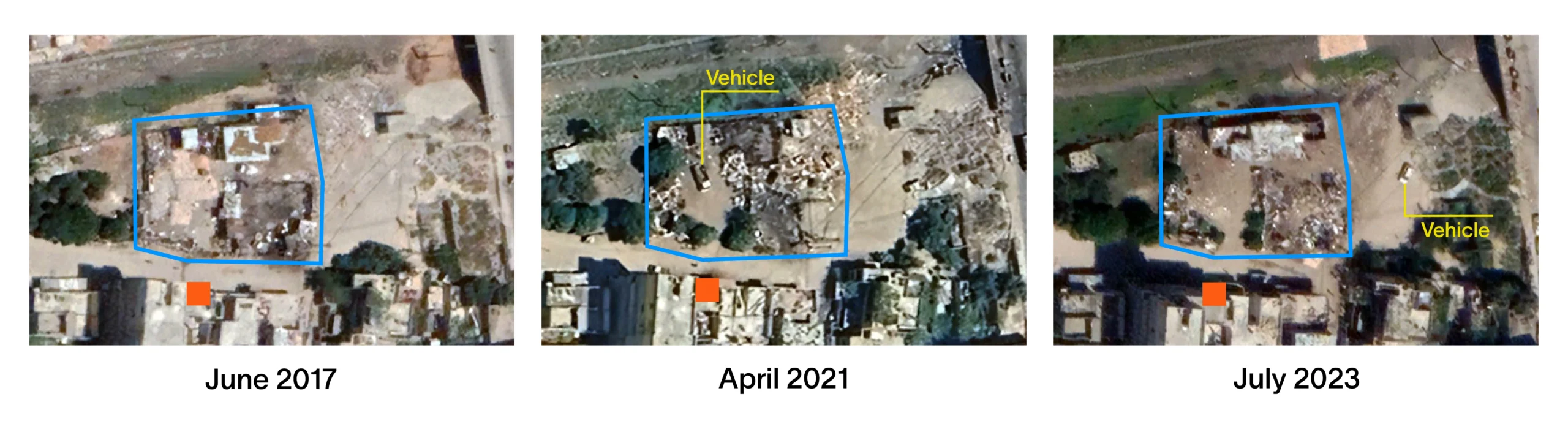
- The proximity of the site to potential logistical infrastructures for metal transport: The site of the explosion and assumed scrap yard are right next to (1) a main roadway between Al-Raml camp and the rest of Latakia city, and (2) railroad tracks which connect to the Latakia commuter railway station and the Latakia port itself. The site and presumed scrapyard are directly connected via an unpaved outlet to one of a few paved main roads connecting the camp to the bordering Al-Orouba Street. Satellite images also show direct proximity to Latakia railway networks, although the lack of movement of nearby freight containers over the span of 10 years indicates a lacking capability/reliance regarding railroad freight transport in Latakia port-city as opposed to maritime and truck transportation.
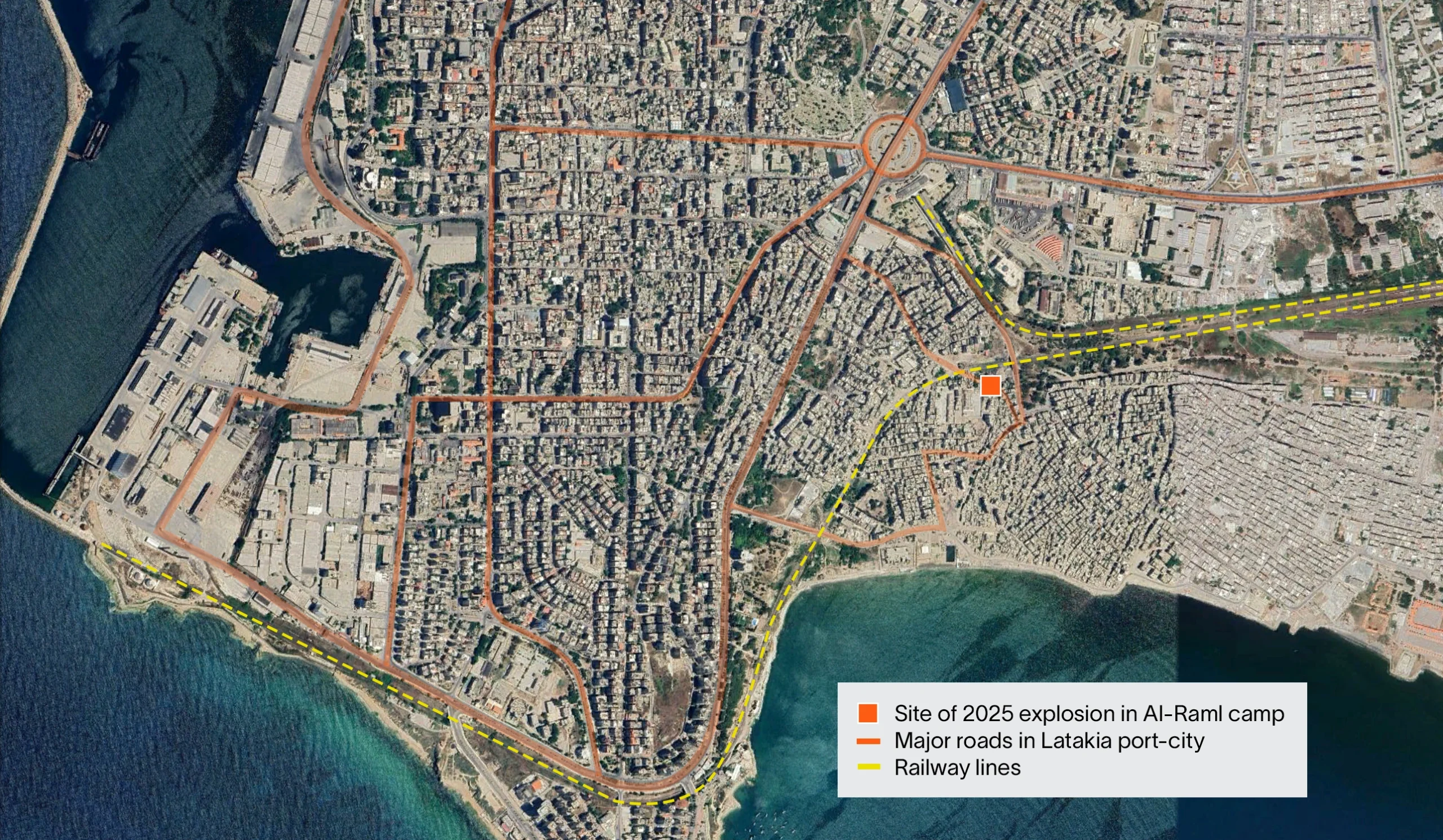
- The conditions of the surrounding built environment: The consistent appearance of deteriorating building conditions are observable over the course of 10 years, most noticeable in social media videos from the 2025 explosion, showing the extensive destruction of building facades far beyond the blast radius. This indicates ongoing patterns of destruction and degradation in the built environment faced by Al-Raml camp residents, outside of the immediate incident of the March 2025 explosion.
While these observed site-conditions do not conclusively establish the logistical flows from the scrap processing site outwards to the rest of Latakia port-city, this spatial analysis approach can be applied across geographic and chronological time scales to indicate the growth of other potential metal trade sites (as identified by physical assemblages of metal), their proximities to logistical transport routes, and the possible modes of logistical transportation (cars, railroad freight, ships). Connections can be made from the micro- to macro-scale of Syria’s metal trade by comparing visible activity in metal processing operations from scrap yards to larger factories as well as appearances of metal freight present at ports and in land truck convoys.
Combined with the knowledge we have on the material conditions of the Palestinian camp residents and the ongoing implementation of new government policies to shape and regulate the metal trade in Syria, we believe geolocation is a useful methodology to corroborate on-the-ground testimonies and reporting about the metal trade, particularly scrap metal sites, and make connections about logistical networks that can facilitate the metal trade in Syria. Focusing on incidents at the hyperlocal level of the working class offers chances to analyze the effectiveness and responsiveness of government policies to address the conditions of the most marginalized Syrian people.
Conclusion
In examining the dual economics of metal – imported and recycled – we learned how the working-class collecting and processing scrap metal continue to endure the risks of the trade to survive. But we also came across unanswered questions, which we’d like to open up for further research.
Does Hamsho still have a foothold in the metal trade?
Hamsho is said to have relinquished 80% of his commercial assets, including a steel processing plant in Adra Industrial City, and his family members kept their companies, but for now, we cannot conclusively say whether he is still profiting from the current steel trade.
Has the new government’s policies helped Syrians depending on the scrap metal trade to survive?
The new government has issued export bans and the Latakia government sealed off metal sites in their district. But it was too early for us to tell whether these policies have been helpful in regulating the informal scrap economy and reducing the risks for workers depending on the trade to survive.
Can UXO mapping be used to trace the steel trade?
Initially, we tried to test a hypothesis to determine whether we could use unexploded ordnance mapping to help us track this informal steel trade. Our initial research revealed an overall lack of available data on metal imports and exports throughout Syria, which made it difficult for us to investigate this material on a larger scale. We offer our case study as an example of how to use geolocation to identify other scrap sites and analyze how their surrounding geography and infrastructure can reveal insights amidst lack of other data.
- Map, MarineTraffic. “CMA CGM Navegantes (Ship, IMO 9303780) — Vessel Details.” October 27, 2025.
CMA CGM. “LRX – Levant Red Sea Express (Line & Services Flyer).” October 27, 2025. ↩︎ - Enab Baladi. 2025. “CMA CGM Container Ship NAVEGANTES Arrives at Syria’s Port of Latakia.” October 14, 2025. ↩︎
- Enab Baladi. 2025. “CMA CGM Container Ship NAVEGANTES Arrives at Syria’s Port of Latakia.” October 14, 2025. ↩︎
- Enab Baladi. 2025. “Ministry of Economy Prevents Export of Scrap and Metal Alloys – Enab Baladi.” Enab Baladi. May 14, 2025. ↩︎
- Enab Baladi. 2025. “Ministry of Economy Prevents Export of Scrap and Metal Alloys – Enab Baladi.” Enab Baladi. May 14, 2025. ↩︎
- Enab Baladi. 2025. “Ministry of Economy Prevents Export of Scrap and Metal Alloys – Enab Baladi.” Enab Baladi. May 14, 2025. ↩︎
- Meta. “Video post.” Facebook, accessed November 8, 2025. ↩︎
- Enabbaladi. 2025. “CMA CGM Container Ship NAVEGANTES Arrives at Syria’s Port of Latakia.” Enab Baladi. Enabbaladi. October 14, 2025. ↩︎
- Porter, Louise. 2025. “Assad Regime Bombed Aleppo for Years—Then Profited from Its Scrap Metal.” The National News, January 1, 2025. ↩︎
- Taylor, Brian. 2025. “Recycled Metal Portrayed as Former Dictator’s Fiefdom.” Recycling Today, January 6, 2025. ↩︎
- Porter, Louise. 2025. “Assad Regime Bombed Aleppo for Years—Then Profited from Its Scrap Metal.” The National News, January 1, 2025. ↩︎
- Aldassouky, The Economic Networks of the Fourth Division, 2020. ↩︎
- Image, The Syria Report. Decision 3592 — Establishment of Syrian Metals and Steel Council. December 22, 2015. ↩︎
- Syria Report. Hamsho International Group. January 27, 2025. ↩︎
- The Syria Report, “Mohammad Hamsho Leads Syrian Metals Council,” 2015. ↩︎
- The Syria Report, “Business Profile: Mohammad Hamsho,” July 19, 2022. ↩︎
- Syria Legal Development Programme (SLDP) and Human Rights Watch (HRW). 2022. Guide on Human Rights-Compliant Procurement Processes in Syria. ↩︎
- Katt, M., B. Deeb, M. Bassiki, A. Obaid, C. Alfred, C. Hadjimatheou, and K. Gunning. 2023. “The Rubble King: Assad Is Demolishing Opposition Neighbourhoods.” Lighthouse Reports, December 13, 2023. ↩︎
- Aldassouky, The Economic Networks of the Fourth Division, 2020. ↩︎
- Aldassouky, The Economic Networks of the Fourth Division, 2020. ↩︎
- Sarhan, Ibrahim. 2025. “Salvaging Iron from Syria’s Ruins a Risky Trade, but ‘a Way to Live.’” Syria Direct, June 4, 2025. ↩︎
- Enab Baladi. 2025. “Ministry of Economy Prevents Export of Scrap and Metal Alloys.” May 14, 2025. ↩︎
- Syria Direct. “Salvaging Iron from Syria’s Ruins, a Risky Trade, but ‘a Way to Live’.” June 4 2025.
Reuters. “In North Syria, Business Hub Hopes to Drive Recovery from War.” Reuters, April 11, 2022. ↩︎ - “Al-Raml (Latakia) Refugee Camp.” 2023. Interactive Encyclopedia of the Palestine Question – Palquest. 2023. ↩︎
- “Al-Raml (Latakia) Refugee Camp.” 2023. Interactive Encyclopedia of the Palestine Question – Palquest. 2023. ↩︎
- The Syria Report, “Demolitions Target Palestinian Refugee Camp in Lattakia.” 2020. ↩︎
- Philipp, Jennifer. 2025. “A Nation in Poverty: An Analysis of Being Poor in Syria – the Borgen Project.” The Borgen Project. September 6, 2025. ↩︎
- “Al-Raml (Latakia) Refugee Camp.” 2023. Interactive Encyclopedia of the Palestine Question – Palquest. 2023. ↩︎
- 963. 2025. “Job Layoffs in Syria: The Ramifications, Legitimacy, and Government Justifications.” 963+. March 9, 2025. ↩︎
- Video, “More bodies recovered from under rubble | The number of fatalities of explosion of unexploded rocket in building in Latakia jumps to 16,” The Syrian Observatory for Human Rights, March 16, 2025.
DPA Middle East. “At Least Three People Killed in Explosion in Syria’s Latakia.” ANews. March 15, 2025.
Arab News. 2025. “Toll from UXO Blast in Syria City Rises to 10: State Media | Arab News.” YouTube. March 16, 2025. ↩︎ - Video, Syria Civil Defence. “Tweet.” X (formerly Twitter). Accessed November 8, 2025. ↩︎